


A crack in an SKF FNL513A cast flanged housing calls for a shutdown and an inspection of the complete support assembly. Replacing the casting may restore the machine temporarily, but an uneven mounting face, excessive shaft load, or forced alignment can damage the replacement in the same way. The useful question is what stressed the housing enough to crack.
Start by recording the crack location and the conditions under which it appeared. Damage discovered immediately after installation suggests a different investigation from a crack that develops after repeated starts, belt adjustments, or process changes. Treat these patterns as clues, then compare them with mounting measurements, bearing condition, and operating history.
Preserve the evidence before removing the housing
Isolate the machine, secure any suspended or stored loads, and support the shaft independently before loosening mounting bolts. A cracked flange may still be carrying load, and removing its fasteners can allow the shaft or attached equipment to move.
Photograph the housing in place. Include the crack, bolt positions, washers, shims, mounting face, and the direction of belt tension or other external forces. Record recent maintenance, changes in operating duty, and any vibration or temperature increase. Keep the damaged casting for examination.
Clean the suspect area gently enough to distinguish a casting surface mark, paint fracture, or corrosion line from an actual crack. Avoid grinding the area before inspection because it can remove evidence. Where visual examination is inconclusive, suitable nondestructive testing can help establish whether a crack exists and how far it extends. The method should suit the casting material and surface condition.
A quiet bearing does not make a cracked housing serviceable. The casting must maintain bearing support and transfer forces into the machine structure; a structural crack compromises that function even before noise becomes obvious.
Use crack location to direct the investigation
Crack position helps narrow the inspection, but it rarely proves a single cause. Installation stress and operating load can act together: a flange already bent against an uneven support has less margin when the machine experiences a shock load.
Inspect the opposite side of the flange as well. Rust trails, polished contact patches, and displaced paint can reveal movement that is less obvious from the crack itself. If the bearing has seized or suffered severe internal damage, investigate that failure too: abnormal bearing forces may have contributed to the housing damage.
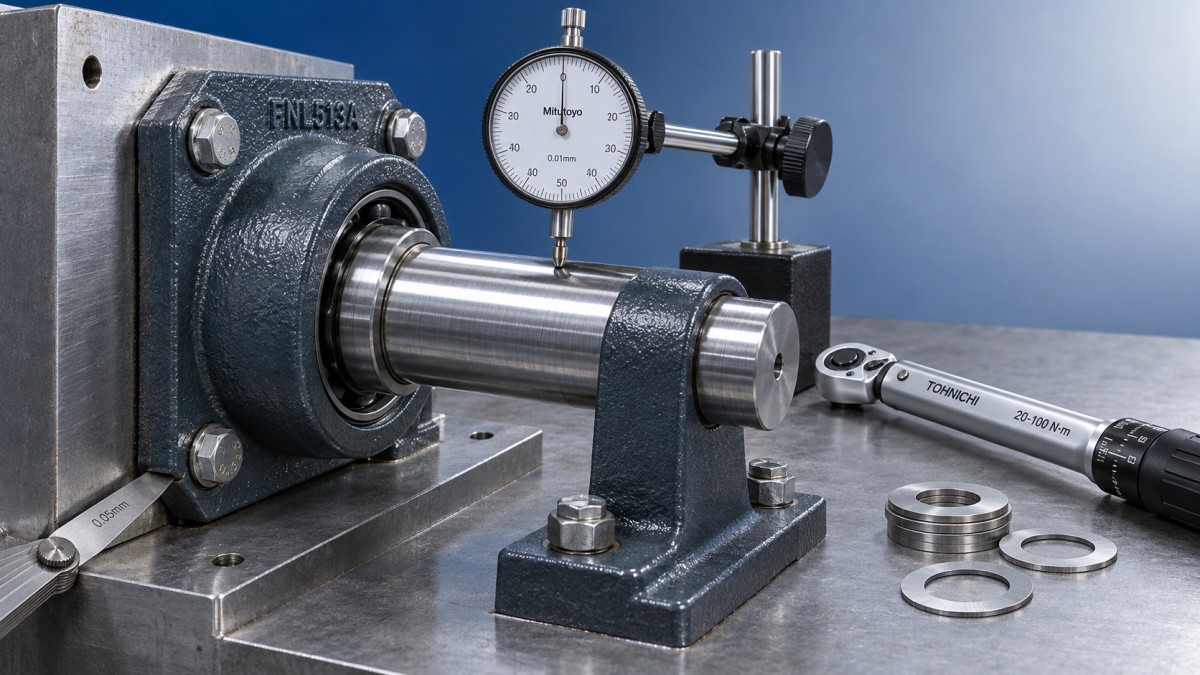
Check whether the flange was pulled onto an uneven surface
A mounting bolt should clamp a supported flange against its mounting face. When a gap exists beneath part of the flange, tightening the bolt can bend the casting as it pulls that area toward the support. This introduces stress before the shaft starts rotating.
Remove dirt, thick paint buildup, burrs, corrosion scale, and old sealing material from the contact area. Examine the support for raised edges around holes, welding distortion, dents, and local crushing. Check both the housing mounting face and the machine support; cleaning one surface does not establish that the joint is flat.
Use appropriate measuring equipment to assess flatness and contact. During a controlled fit check with the shaft supported and the assembly unloaded, look for rocking or gaps before final tightening. If the housing changes position as individual bolts are tightened, investigate the contact surface and alignment rather than applying more torque.
Shimming can be appropriate when it forms part of the mounting arrangement, but the support must remain stable and distribute clamping loads adequately. A small improvised shim beneath one bolt can leave adjacent areas unsupported. Correct a distorted mounting plate or unsuitable support instead of trying to compensate through fastener force.
Review the bolts, washers, thread condition, and tightening procedure together. Use the specified fasteners and torque procedure for the assembly, including the stated lubrication condition. Tighten progressively in a sequence that seats the flange evenly. Thread friction affects clamping force, so adding lubricant while retaining a torque value intended for dry threads can change the stress applied to the joint.
Reconstruct the load at the bearing support
The machine's normal running load is only part of the investigation. Starts, stops, jams, reversing motion, and impacts can produce forces that are absent during a steady running check. Compare the current operating conditions with those used to select the bearing arrangement and housing.
- Belt or chain tension: Review recent adjustments and the drive's tensioning method. Extra tension increases the force transmitted through the shaft to its supports.
- Overhung components: Check pulleys, sprockets, impellers, and other loads outside the bearing span. Their position changes the reactions at each support.
- Process changes: Look for increased throughput, heavier material, recurring blockages, or a changed drive arrangement.
- Dynamic forces: Inspect for imbalance, damaged rotating components, loose connections, and structural movement.
- Axial forces: Determine how thrust and shaft thermal expansion are accommodated throughout the bearing arrangement.
Load direction matters as well as magnitude. Forces acting away from the mounting plane can load the flange and its fasteners differently from forces acting within it. Review housing suitability for the actual direction of force and the complete mounting arrangement. The bearing's load rating alone does not establish the capacity of the housing, bolts, or supporting plate.
If failure followed a belt adjustment, examine tension and support reactions before selecting a larger bearing. If the crack followed a jam, inspect the drive protection and the force path through the assembly. Changing the bearing without addressing either condition may leave the cause intact.
Separate bearing misalignment from housing distortion
A self-aligning bearing can accommodate angular misalignment within its design limits. That capability does not allow a flange housing to be bolted onto a twisted surface or forced into position around an incorrectly located shaft.
Check shaft straightness, the relative positions of adjacent supports, and coupling alignment. Watch for an assembly that fits only when bolts are used to draw it into place. That can introduce forces into the bearing and casting even though the flange appears fully seated afterward.
Also review the locating and non-locating functions of the bearings. Where shaft expansion must be accommodated, unintended restraint can generate additional axial load as temperature rises. Inspect the arrangement as a system rather than assuming that every support should hold the shaft axially.
Select replacement parts by their role in the assembly
For a structural housing crack, replacement is the normal corrective route. Welding, adhesive repair, or reinforcing plates can alter the casting's dimensions and load transfer. Any proposed repair needs an engineered procedure and acceptance criteria; an improvised patch does not establish restored capacity.
Inspect the bearing, shaft seating surfaces, seals, and locating components before ordering parts. Housing distortion may have damaged the bearing, but a housing crack alone does not prove that every associated component requires replacement.
Keep different bearing arrangements separate when reviewing spares. An INA GSH35-2RSR-B Insert Ball Bearing may be relevant to an insert-bearing assembly elsewhere on the machine. Its product type or bore size does not establish interchangeability with the bearing arrangement inside an FNL513A housing. Match the housing seat, shaft attachment, sealing arrangement, and load requirements before considering a substitute.
Return to service only after correcting the contributing conditions
Install the replacement on a sound mounting surface with the shaft aligned and supported. Confirm the bearing seating, locating arrangement, seals, lubrication, and fastener tightening before running.
During a controlled restart, monitor vibration, temperature, noise, and movement at the mounting joint. Compare observations under similar speed and load conditions. Record the measurements and corrections alongside the crack photographs so that future inspections can assess whether the problem has returned.
The repair is complete when the assembly has a sound housing and a credible load path through the bearing, flange, fasteners, and machine support. If uneven contact, forced alignment, or an unexplained load increase remains, resolve it before returning the machine to normal duty.
Navigation
Send Us A Message
consult

Jinan Lanyu Import & Export Co., Ltd. is a bearing manufacturing enterprise specializing in the import and export trade of bearings. Covering a total area of 50,000 square meters, the company boasts an annual production capacity exceeding 20 million sets and is dedicated to the manufacture of high-quality bearings.

First class quality service and professional after-sales team.
Get in Touch
*We respect your confidentiality and all information are protected.
