


When people buy a precision angular contact bearing, they usually focus on brand and size first. In real use, the bigger performance difference often comes from two less obvious points: contact angle and preload. If you are looking at the SKF 7008CEHCP4A Angular Contact Ball Bearing for a spindle, high-speed motor, or another accuracy-sensitive assembly, these are the checks that actually decide whether the bearing runs smooth, runs hot, or fails early.
A lot of problems blamed on lubrication or machining start here. The bearing may be correct on paper, but the contact angle does not match the load direction, or the preload is too light for stiffness and too heavy for speed. That is where end users lose accuracy, noise level, and service life.
Start with the load path, not the catalog code
Before comparing arrangements, check how the shaft is actually loaded. An angular contact ball bearing is built to carry combined loads, which means radial load plus axial load. The contact angle determines how strongly the bearing can support axial force in relation to radial force. In practical terms, the larger the contact angle, the better the axial load capacity, but that usually comes with a tradeoff in speed potential and running characteristics.
If your application sees mostly radial load with occasional axial positioning, a setup chosen only for stiffness can be excessive. If the machine sees constant thrust load, especially in one direction, choosing without checking the load direction is a common mistake. The bearing may still fit the shaft and housing, but performance will be wrong from day one.
Understand what the contact angle changes in use
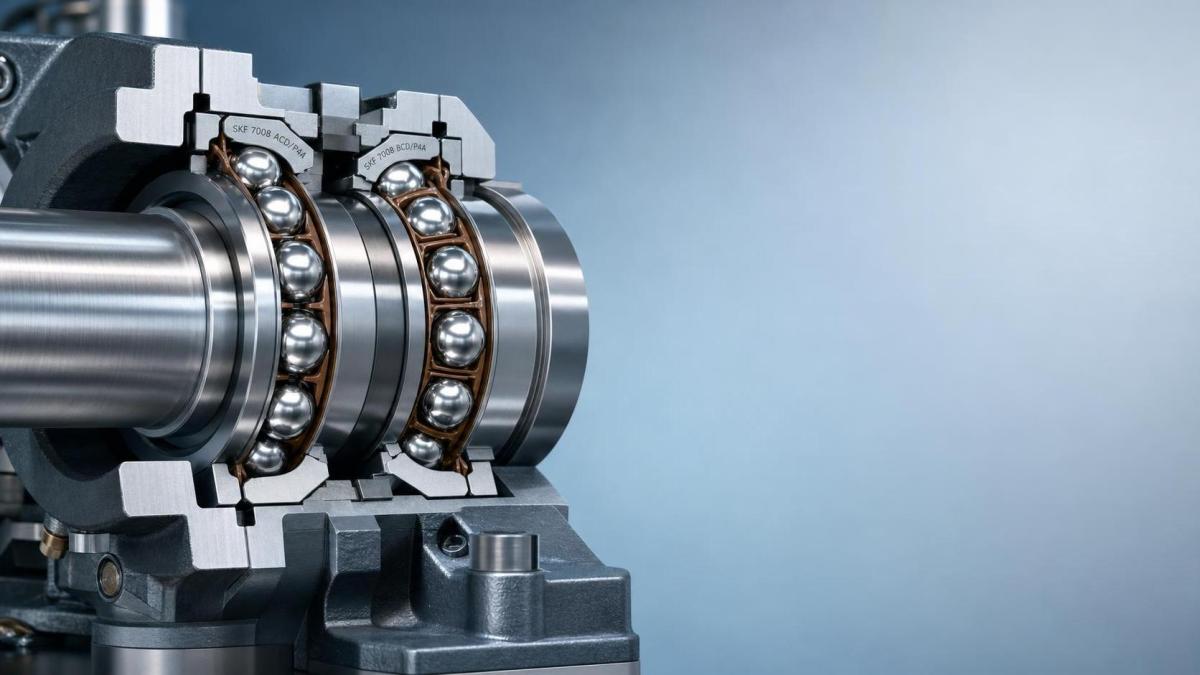
For the SKF 7008CEHCP4A Angular Contact Ball Bearing, contact angle is not just a design detail. It affects four things that users notice quickly:
- Axial load support: more contact angle generally means stronger thrust handling.
- Rigidity: the bearing system resists deflection better when matched correctly to the working load.
- Speed behavior: a configuration optimized for thrust and stiffness can generate more heat at high speed if preload and lubrication are not matched.
- Running accuracy: incorrect angle selection can show up as vibration, positional drift, or unstable surface finish in precision equipment.
This is why two machines using the same bearing size can require very different arrangements. One may need stable axial positioning under varying cutting force. Another may need lower heat and smoother high-speed running. Same envelope, different answer.
Check preload as a working condition, not a number alone
Preload is the internal force applied to remove play and increase rigidity. Many buyers hear that more preload means better precision. That is only half true. Too little preload allows elastic movement, poor repeatability, and noise. Too much preload raises friction, temperature, and wear, especially when speed goes up or thermal expansion starts changing internal conditions.
The useful question is not “Do I need preload?” but “What happens after installation, speed rise, and operating temperature?” A preload that feels correct during assembly can become excessive once the shaft grows thermally more than the housing. In a tight precision system, that change matters.
What to check before deciding preload level
- How much axial positioning accuracy the machine really needs.
- Whether the bearing set will run at sustained high speed or only intermittent speed.
- Expected temperature difference between shaft and housing.
- Whether the arrangement is single, paired, or part of a more complex spindle system.
- Lubrication method, because grease and oil do not behave the same way under preload and speed.
If you cannot answer those five points, preload selection is still premature.
Watch the arrangement as closely as the bearing
A good bearing can perform badly in the wrong pairing or mounting arrangement. Back-to-back and face-to-face sets do not behave the same under moment load and shaft deflection. Users sometimes replace an existing set with the same nominal bearing but overlook the original arrangement and spacer condition. The result is confusing: the machine restarts, but stiffness or temperature behavior changes immediately.
Do not treat temperature rise as a minor symptom
When contact angle and preload are mismatched, temperature is usually one of the first signs. Users often respond by changing grease first. Sometimes that helps, but if preload is fundamentally too high for the operating speed, lubrication alone will not solve it. Heat, then noise, then loss of accuracy tends to follow.
A practical check is to compare start-up behavior with stabilized running behavior. If temperature keeps climbing beyond the normal warm-up phase, especially after replacement or rebuild, review preload, fit, and arrangement before assuming contamination or lubricant quality is the main cause.
Know when your application does not need angular contact design everywhere
Not every position in a machine needs the same bearing concept. In many industrial assemblies, one position handles precision axial location while another mainly carries radial load. That is where a deep groove bearing may be more appropriate as the secondary support, provided the load case and clearance are matched correctly.
For example, a replacement plan may combine a precision angular contact location bearing with a radial support bearing such as NTN-6214CM-Deep Groove Ball Bearing in industrial applications where the housing layout, fit class, and axial constraint strategy allow it. The available options for P0 to P4 precision grades and C2 to C5 clearances matter here, because the support position should be chosen around actual internal clearance and fit behavior, not simply by bore and outside diameter.
The installation check is where many good selections go wrong
Even the right SKF 7008CEHCP4A Angular Contact Ball Bearing will not forgive careless mounting. A few points are worth slowing down for:
- Check shaft and housing seats for burrs, taper error, and shoulder damage.
- Confirm the bearing orientation matches the intended thrust direction.
- If spacers are used, verify face quality and thickness consistency.
- Apply mounting force through the correct ring. Passing force through the rolling elements can damage a new bearing before it even runs.
- After assembly, rotate by hand and listen for roughness before full-speed startup.
That last check sounds basic, but it catches surprising numbers of avoidable issues.
A practical way to make the decision
If you are selecting or replacing this bearing, work in this order: define the real axial load direction, review speed and heat conditions, choose the arrangement, then decide preload around operating behavior rather than assembly feel. After that, verify fits, mounting surfaces, and lubrication method. This sequence is more reliable than picking by part number first and troubleshooting after installation.
For end users, that is the useful takeaway. Contact angle decides how the bearing wants to carry the load. Preload decides how tightly the system behaves while doing it. Get both aligned with the machine, and the bearing has a fair chance to deliver the accuracy, rigidity, and life you paid for.
Navigation
Send Us A Message
consult

Jinan Lanyu Import & Export Co., Ltd. is a bearing manufacturing enterprise specializing in the import and export trade of bearings. Covering a total area of 50,000 square meters, the company boasts an annual production capacity exceeding 20 million sets and is dedicated to the manufacture of high-quality bearings.

First class quality service and professional after-sales team.
Get in Touch
*We respect your confidentiality and all information are protected.
