


Where NTN-NJ206ET2X Makes Sense in Industrial Equipment
The real question with NTN-NJ206ET2X-Spherical roller bearing is not whether it can run in industrial equipment, but whether the equipment creates the kind of load path and shaft behavior that justify using it. In distribution work, that distinction matters. A bearing that performs well in a catalog description can still be the wrong answer on site if the machine sees frequent shaft deflection, impact loading, or mounting conditions that are less controlled than the drawing suggests. This is why these bearings tend to be discussed most often around conveyors, fans, crushers, vibrating sections, and gear-driven rotating assemblies rather than general-purpose light-duty machinery.
For dealers and equipment service teams, the strongest application fit usually appears where radial load is substantial and operating hours are long enough that premature bearing replacement becomes a maintenance problem, not just a parts issue. In those environments, the value of a spherical roller design is tied to its ability to tolerate misalignment and maintain stable running under conditions that would shorten the life of more alignment-sensitive bearing arrangements.
This is one reason the NTN-NJ206ET2X discussion often comes up in bulk material handling. Conveyor pulleys, take-up systems, and associated drive sections rarely operate in laboratory conditions. Frames move, foundations settle slightly, dust enters the system, and belt tension is not always as even as the original design intended. When a bearing position sees constant radial force plus minor shaft misalignment, spherical roller configurations are often considered because they are more forgiving in service than many rigid alternatives. That does not mean every conveyor position should use one. High-speed, lightly loaded positions may be better served by another bearing type. But on slower, heavily loaded, continuously operating stations, the operating logic becomes much stronger.
The same pattern shows up in quarry and aggregate equipment. Screens, feeders, and crusher support assemblies do not fail bearings only because of load magnitude. They fail them because load is irregular, contamination is persistent, and maintenance windows are limited. A bearing selected for this kind of equipment has to survive reality: shock, vibration, imperfect sealing, and installation practices that may be acceptable in the field but not ideal on paper. That is where application judgment matters more than brand preference alone.
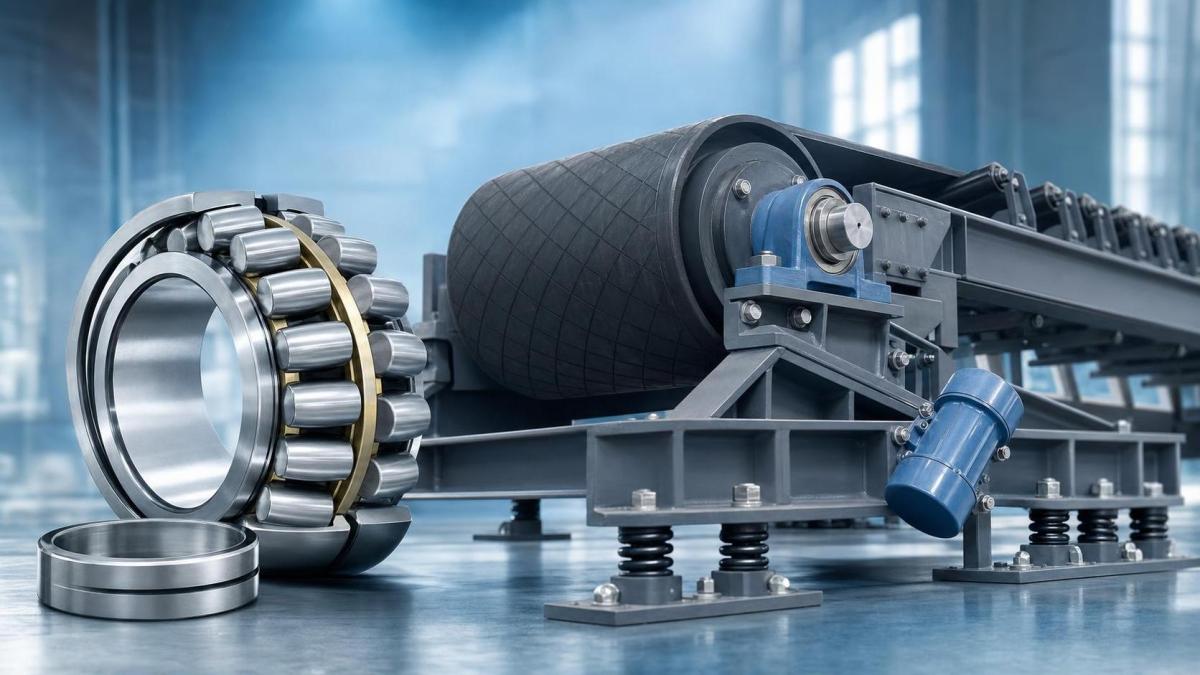
Fans and blowers are another case where people sometimes underestimate the importance of site conditions. In a clean HVAC-style system, selection priorities can lean toward speed and efficiency. In cement, mining, wood processing, or dust-handling ventilation lines, bearing conditions change. Housing distortion, thermal variation, and airborne contamination start to influence service life more directly. If the shaft is long, the support spacing is wide, or thermal growth affects alignment over a shift, a spherical roller bearing may be chosen because it offers more tolerance for what actually happens in operation, not just for what appears in the mechanical layout.
Where Selection Errors Usually Happen
A common mistake is treating all heavy-duty rotating equipment as automatically suitable for this bearing type. That is too broad. Selection should be checked against at least four practical conditions: shaft speed, load direction, misalignment expectation, and lubrication discipline. If speed is high and heat control is already difficult, a different internal design may be more appropriate. If axial load dominates the application, the bearing arrangement needs closer review. If lubrication intervals are inconsistent, even a robust bearing can be damaged by grease starvation or contamination wash-in long before its theoretical life is reached.
This is also where customer questions become more useful than generic specification comparisons. When someone asks whether NTN-NJ206ET2X-Spherical roller bearing can replace an existing unit, the better response is usually to ask what failed in the old arrangement. Was it overheating? Cage damage? Outer ring creep? False brinelling during standby vibration? Seal failure that led to contamination? Without that context, replacement decisions become guesswork.
In export and replacement supply work, another practical point comes up regularly: dimensional familiarity is not enough. Buyers often focus on shaft size first, but the better starting point is the entire operating envelope. A bearing position with the same shaft diameter can behave very differently in a kiln fan, a bucket elevator head pulley, or a compact gearbox. The correct recommendation depends on more than nominal interchangeability.
That is why some supply discussions naturally broaden into adjacent bearing options. In applications where the end user is comparing service life across mixed equipment fleets, a product such as FAG 22217-E1-XL Spherical roller bearing may enter the conversation, especially when the machine arrangement calls for an 85 mm bore, 150 mm outer diameter, and 36 mm width, or when the buyer needs flexibility across precision grades from P0 to P4 and clearances from C2 to C5. Those details matter less as sales features than as indicators of how closely the bearing can be matched to installation accuracy, heat behavior, and running clearance requirements.
Good Fits in Process Industries
Paper, steel, cement, and general process plants often create the most realistic use cases because downtime cost is visible there. A bearing in these environments is rarely judged only by initial price. Maintenance teams care about whether it can stay stable between shutdowns, whether lubrication can be handled with existing routines, and whether the housing arrangement leaves enough margin for imperfect alignment. In this kind of plant, spherical roller bearings are often selected not because conditions are ideal, but because conditions are not ideal and never will be.
Even then, there are limits. If the housing is worn, the shaft seat is out of tolerance, or sealing has already failed repeatedly, changing the bearing alone may not solve the problem. This is one of the more expensive misunderstandings in aftermarket supply. The bearing gets blamed for a system issue. Experienced distributors usually look at the full chain: shaft condition, housing fit, lubrication method, operating temperature, and contamination source. If those are not addressed, the replacement cycle simply repeats.
For Jinan Lanyu, working across import and export trade in deep groove ball bearings, self-aligning ball bearings, and cylindrical roller bearings makes this comparison easier to explain to buyers. The selection logic is not that one category is universally better. It is that each one tolerates a different combination of speed, load, misalignment, and maintenance discipline. NTN-NJ206ET2X-Spherical roller bearing tends to be most persuasive where the equipment is expected to keep running under load even when alignment and contamination control are less than perfect.
A sound recommendation usually comes from a short list of practical checks: what load is dominant, how stable the shaft alignment remains during operation, how often lubrication is actually performed, and whether the failure history points to overload, contamination, or mounting error. Once those answers are clear, the application fit becomes much easier to judge than it looks from the model number alone.
Navigation
Send Us A Message
consult

Jinan Lanyu Import & Export Co., Ltd. is a bearing manufacturing enterprise specializing in the import and export trade of bearings. Covering a total area of 50,000 square meters, the company boasts an annual production capacity exceeding 20 million sets and is dedicated to the manufacture of high-quality bearings.

First class quality service and professional after-sales team.
Get in Touch
*We respect your confidentiality and all information are protected.
