


What is a tapered roller bearing in real working conditions?
A tapered roller bearing is built to support radial load and axial load at the same time.
Its design improves load distribution, running stability, and service life in demanding bearing applications.
This matters in automotive systems, industrial gearboxes, conveyors, and heavy equipment.
For global bearing trade, knowing what is a tapered roller bearing helps improve selection accuracy and reduce replacement risk.
Jinan Lanyu supplies multiple bearing categories, including deep groove ball bearings, self-aligning ball bearings, and cylindrical roller bearings.
Why do different application scenes require different bearing judgments?
A tapered roller bearing performs best when load direction, speed, lubrication, and alignment are clearly understood.
The same bearing structure may work well in one machine but fail early in another.
That is why application scene analysis is more useful than a simple product definition.
Automotive wheel end and transmission scenes
In wheel hubs and transmissions, a tapered roller bearing handles shock, cornering force, and continuous rotation.
Key checks include preload setting, heat generation, sealing performance, and fatigue resistance.
Industrial machinery and gearbox scenes
In gearboxes, crushers, and rolling systems, a tapered roller bearing supports heavy combined loads.
Here, lubrication quality and mounting precision often matter more than catalog load ratings alone.
Heavy-duty and low-speed shock-load scenes
Construction and mining equipment often face contamination, vibration, and impact.
For these scenes, material strength, internal clearance, and housing rigidity become critical selection points.
How does a tapered roller bearing work?
The rolling elements are tapered, and their contact lines meet at a common point on the shaft axis.
This geometry lets the bearing carry combined loads efficiently while reducing sliding friction.
Compared with some other bearing types, it offers strong axial support and precise running behavior.
What scene-based differences should be compared before selection?
Which practical bearing options can support broader application needs?
Not every machine uses a tapered roller bearing as the final solution.
Some axial or mixed-load systems may require spherical roller designs for misalignment tolerance.
One useful reference is SKF 29320E Axial-spherical Roller Bearing.
It features Chrome steel GCr15, a 100 mm bore, 170 mm outer diameter, and 42 mm width.
Available precision grades include P0, P6, P5, and P4, with C2 to C5 clearance options.
This shows how scene matching should consider load direction and alignment, not only size.
What common mistakes lead to poor application results?
- Choosing only by dimension, without checking axial load.
- Ignoring preload or clearance during installation.
- Using unsuitable lubrication for speed or temperature.
- Missing contamination control in harsh environments.
What should be the next step for better bearing decisions?
Start with the real application scene, then confirm load, speed, alignment, and sealing needs.
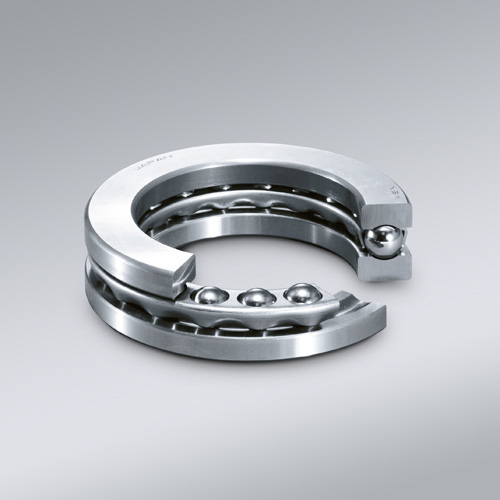
 Thrust ball bearingsCharacteristics and uses of thrust ball bearings:
Plane thrust ball bearings are divided into unidirectional and bidirectional types. Unidirectional plane thrust ball bearings are steel balls installed between a set of raceways. The contact angle is generally 90°. They can only withstand unidirectional axial loads and are not suitable for high-speed rotation. This type of bearing can be separated into three pieces, commonly known as three-piece bearings. Both gaskets have arc-shaped deep grooves for ball rolling. Cylindrical roller bearingsCharacteristics and uses of cylindrical roller bearings:
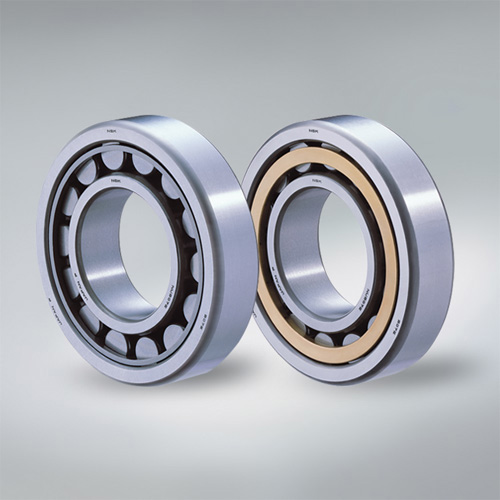
Cylindrical roller bearings are separable bearings, whose inner and outer rings are in linear contact with the rollers, with a small friction coefficient and a high maximum speed. The bearings are easy to install and disassemble, and can generally only bear radial loads. Only single-row cylindrical roller bearings with inner and outer ribs can bear smaller quantitative axial loads or larger clearance axial loads; bearings with single ribs can only bear axial loads in one direction; cylindrical roller bearings without inner or outer rings are used in parts with limited radial dimensions. The surface of the journal or housing hole is directly used as the rolling surface, and its surface hardness, processing accuracy and surface quality should be similar to the raceway of the ring.
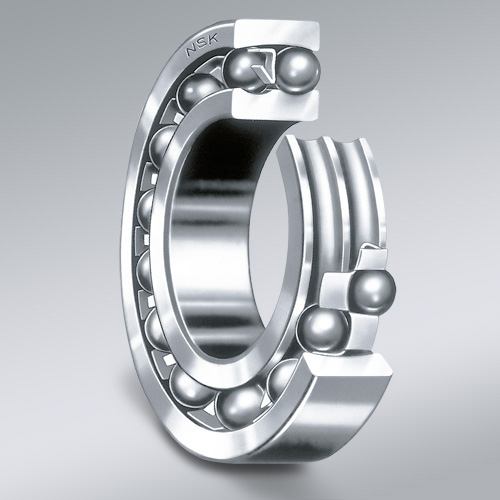
Cylindrical roller bearings can be divided into single-row, double-row and multi-row cylindrical roller bearings according to the number of rows of roll Self-aligning ball bearingsCharacteristics and uses of self-aligning ball bearings:
The inner ring of the self-aligning ball bearing has two raceways, and the raceway of the outer ring is spherical, and the center of curvature of the spherical surface is consistent with the center of the bearing. Therefore, the inner ring, ball and cage can be tilted freely relative to the outer ring. Therefore, the deviation caused by the processing error of the outer shell can be automatically adjusted.
Navigation
Send Us A Message
consult

Jinan Lanyu Import & Export Co., Ltd. is a bearing manufacturing enterprise specializing in the import and export trade of bearings. Covering a total area of 50,000 square meters, the company boasts an annual production capacity exceeding 20 million sets and is dedicated to the manufacture of high-quality bearings.

First class quality service and professional after-sales team.
Get in Touch
*We respect your confidentiality and all information are protected.
