


Sometimes the first sign of a lubrication problem is not dramatic. A motor starts running a little hotter than usual. A fan develops a faint noise that operators ignore for a few weeks. A conveyor shaft feels slightly rough during a manual rotation check. In many workshops, these early signs are easy to miss because deep groove ball bearings often keep working even when lubrication is no longer in good condition.
That is exactly what makes lubrication tricky. When it is correct, nobody pays attention. When it is wrong, the bearing may already be dealing with rising friction, contamination, grease separation, or metal-to-metal contact. For anyone responsible for maintenance, purchasing, or equipment reliability, a practical deep groove ball bearing lubrication guide is less about theory and more about avoiding preventable wear, unstable operation, and unnecessary replacement work.
Proper lubrication is essential to maximize the performance, service life, and reliability of deep groove ball bearings. In daily industrial use, the challenge is usually not whether to lubricate, but how to choose the right lubricant, how much to apply, and when to relubricate without causing a second problem by overfilling.
When lubrication problems look like something else
A common mistake is to assume every vibration or temperature rise comes from poor bearing quality or shaft misalignment. Those issues can absolutely exist, but lubrication often sits in the middle of the problem. Grease that is too thick for startup conditions may create drag. Oil that is too light for the load may fail to maintain a stable film. Even a suitable lubricant can become ineffective if water, dust, or old degraded grease remains inside the housing.
Deep groove ball bearings are widely used because they are versatile, simple in structure, and suitable for many operating speeds. That broad use also means they end up in very different environments: small electric motors, agricultural equipment, pumps, fans, gearboxes, and general machinery. A lubrication approach that works in one setting may be unsuitable in another. This is why copied maintenance habits often lead to trouble.
Where many lubrication decisions go wrong
One of the most common misunderstandings is that more grease always means more protection. In reality, excessive grease can churn, create heat, and increase resistance, especially at higher speeds. Another common issue is mixing greases without confirming compatibility. In practice, many people top up a bearing with whatever grease is available, only to find the consistency changes, the oil separates, or the bearing becomes noisier after relubrication.
There is also a habit of choosing lubricant mainly by convenience. If a plant uses one grease for many machines, it may seem efficient to use the same product everywhere. But bearing speed, temperature, seal arrangement, and exposure to contamination all affect whether that choice is reasonable. A deep groove ball bearing lubrication guide should always begin with operating conditions, not shelf availability.
How to choose a lubricant without overcomplicating it
Start with the application itself. If the bearing runs at moderate speed with normal temperature and no unusual contamination, a general-purpose bearing grease may be suitable. If speed is higher, lower internal friction and better grease stability become more important. If the environment includes moisture, washdown, or airborne particles, the lubricant must also help resist contamination and corrosion.
Oil lubrication may be preferred in some systems where heat needs to be removed, speed is high, or the machine already has an oil circulation arrangement. Grease, however, remains the more common option for many deep groove ball bearing applications because it is simpler to retain, easier to apply, and can help exclude contaminants when used correctly.
Viscosity matters more than many people expect. The base oil in the grease or the oil itself has to form an adequate film under actual load and temperature. If the film is too thin, wear risk increases. If it is too heavy, running resistance and heat may rise. For that reason, lubrication selection should be tied to actual operating conditions rather than a generic label.
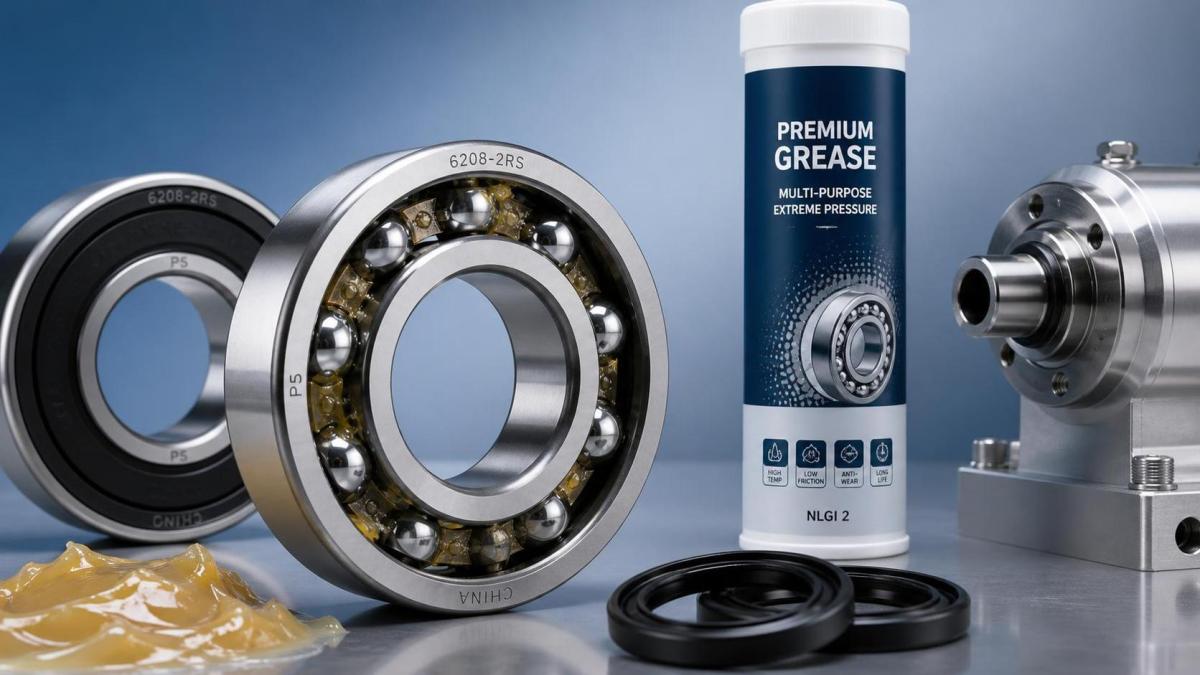
Practical steps before adding fresh grease or oil
Before relubricating, it helps to pause and check the surrounding situation. Is the bearing running hotter than normal because of load changes? Is there evidence of seal damage? Has dust or water entered the housing? If old grease has hardened or turned dark, simply adding new grease on top may not solve the problem. In some cases, the better approach is cleaning, inspecting, and relubricating with the correct quantity.
Pay attention to the path the lubricant takes. Grease nipples, channels, and relief points should not be blocked. A blocked outlet can trap old grease and force pressure into seals. In oil-lubricated arrangements, confirm that levels, flow paths, and return lines are functioning as intended. Many lubrication issues come from delivery problems rather than from the lubricant specification itself.
Relubrication is not just about interval
People often ask for a fixed interval, but relubrication timing depends on speed, temperature, contamination level, duty cycle, and bearing size. A bearing in a clean indoor motor may need a different schedule from one near dust, humidity, or frequent stop-start operation. If the machine has a history of grease leakage or unusual heat after relubrication, the amount may be wrong even if the timing seems reasonable.
It is usually better to think in patterns: how the machine sounds before and after lubrication, whether temperature settles or climbs, whether expelled grease looks normal, and whether vibration behavior changes gradually or suddenly. These observations do not replace technical analysis, but they help identify whether the lubrication practice itself is supporting stable operation.
When lubrication choice connects to broader bearing selection
In some machines, the discussion around lubrication leads to a larger question: is the bearing arrangement itself suitable for the combined loads and speed? Deep groove ball bearings handle many general applications well, but not every shaft system sees only simple radial loading. Where radial and axial loads act together, or where higher rotational accuracy and stiffness matter, engineers may also compare other bearing types, including Angular contact ball bearings.
That comparison is not about replacing one type by default. It is about understanding operating demands. Angular contact designs can bear radial and axial loads at the same time, and their axial load capacity changes with contact angle. Available configurations include 70000 C type, 70000 AC type, 70000 B type, paired DB, DF, and DT arrangements, as well as QJ type options. In applications where speed remains important and axial load behavior needs closer control, this type of selection may influence lubrication planning too, especially when preload, heat generation, and rotation accuracy are part of the operating picture.
Signs that lubrication is improving the situation
You usually will not need dramatic evidence to know things are moving in the right direction. A machine that starts more smoothly, runs with more consistent temperature, or stops producing that irregular dry-sounding noise is often showing that the lubricant film is more stable. Cleaner purge grease, reduced leakage, and less frequent unscheduled attention can also indicate that the lubrication method is better matched to the bearing and environment.
At the same time, it is worth remembering that lubrication cannot correct every issue. If the fit is wrong, the shaft is damaged, the seal arrangement is poor, or the bearing has already suffered significant wear, fresh grease alone will not restore reliable performance. Lubrication works best as part of a maintenance habit that includes inspection, cleanliness, and attention to operating changes.
A few habits that help prevent repeat problems
Keep lubricants clearly identified and stored in clean conditions. Avoid mixing products unless compatibility has been confirmed. Use application tools that reduce contamination risk. Record not just the date of relubrication, but also observations such as noise, expelled grease condition, and temperature behavior. Those short notes often become more useful than generic interval charts.
If a machine repeatedly shows lubrication-related symptoms, revisit the whole setup rather than increasing grease quantity each time. Check seals, operating speed, housing design, and whether the bearing type still matches the actual load pattern. In some cases, a review may also point toward alternatives such as Angular contact ball bearings where combined load handling or axial control is part of the concern.
A useful deep groove ball bearing lubrication guide is really a reminder to slow down and judge the bearing in context. The right lubricant, the right amount, and the right relubrication method can reduce friction, limit premature wear, and support more dependable operation. Most lubrication problems are not mysterious once the conditions around the bearing are examined carefully.
Navigation
Send Us A Message
consult

Jinan Lanyu Import & Export Co., Ltd. is a bearing manufacturing enterprise specializing in the import and export trade of bearings. Covering a total area of 50,000 square meters, the company boasts an annual production capacity exceeding 20 million sets and is dedicated to the manufacture of high-quality bearings.

First class quality service and professional after-sales team.
Get in Touch
*We respect your confidentiality and all information are protected.
