


A low-priced HIWIN Linear slider can become an expensive purchase if it arrives with the wrong preload, does not match the installed rail, or misses a maintenance shutdown. For procurement teams, the real task is not simply finding a supplier. It is establishing exactly what is being supplied, where it comes from, and when it will be ready to install.
Before issuing a purchase order, confirm the complete part code, rail compatibility, product origin, and delivery milestones. These checks turn apparently similar quotations into comparable offers—and reduce the risk of discovering a specification gap when the machine is already stopped.
Start with the component, not the quoted description
“Linear slider” is a common purchasing term, but suppliers may use it to describe a guide block, a carriage, or a complete rail-and-block assembly. A quotation that says only “HIWIN slider, size 25” leaves too much unresolved.
Establish whether the requirement is for a replacement block, a matched assembly, or a new linear guidance system. For a replacement, collect the markings on the existing block and rail, the machine builder’s bill of materials, and any available drawings. Photographs help identify the component, but they should support—not replace—a written specification.
If the original code is unreadable, send dimensional measurements and application details to the supplier for technical review. Do not authorize a substitution solely because mounting holes appear to line up. External fit does not establish the required load capacity, stiffness, running accuracy, or service life.
Decode the HIWIN Linear slider part code before comparing prices
A complete designation can identify much more than nominal size. Depending on the product family, it may distinguish block configuration, length, preload, accuracy, seals, and other options. Code structures vary, so use the current manufacturer documentation for the exact series rather than a generic decoding chart.
Ask the supplier to reproduce the full designation on the quotation and order acknowledgment. If any suffix is omitted, request clarification in writing. “Equivalent specification” should not become permission to supply whichever variant happens to be available.
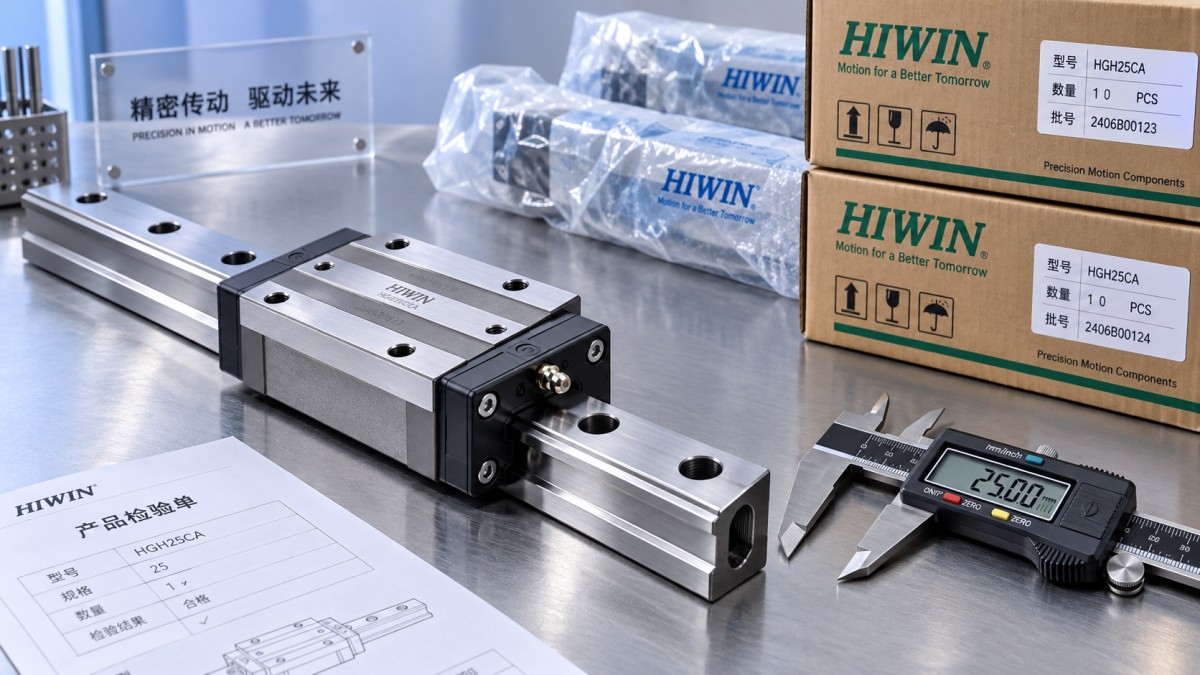
Replacing only the block requires an additional check
Do not assume a new block can be fitted to an existing rail simply because both carry the same brand and size. Interchangeability depends on the series, accuracy requirements, and manufacturer guidance. Some applications require matched rail-and-block combinations.
Higher preload is not automatically a better upgrade. It can increase stiffness, but it also places greater demands on mounting accuracy and may increase running resistance. Let engineering approve changes to preload or accuracy; procurement should record that approval rather than infer suitability from price or availability.
Separate authenticity, manufacturing origin, and shipping location
A supplier’s address tells you where the seller operates, not necessarily where the component was manufactured. Similarly, a shipment dispatched from a particular country does not prove that country is the product’s origin.
Request the declared manufacturing origin for the quoted item and clarify what documentation is available. Depending on the transaction, useful evidence may include:
- Clear photographs of product markings and packaging labels for the offered stock.
- Lot or traceability details, where provided by the manufacturer.
- Commercial documents connecting the supplier to its upstream source.
- Applicable origin documentation when required for customs or internal compliance.
- Confirmation of whether the goods are new, unused, and in original packaging.
No single photograph or label conclusively proves authenticity. Genuine packaging can be reused, and inconsistent markings deserve investigation. When sourcing risk is significant, seek verification through the manufacturer or an authorized channel rather than relying only on a seller’s assurance.
Also distinguish an authorized distributor from an independent reseller. Both may offer genuine goods, but their access to traceability, warranty support, and technical assistance can differ. If authorization is claimed, verify its current status and scope.
Turn “in stock” into a delivery commitment you can evaluate
For a buyer facing a shutdown deadline, “available” is reassuring—but incomplete. It may mean stock in the seller’s warehouse, stock held by another company, or an expected replenishment shipment.
Ask whether the exact part code and quantity are physically available, whether they can be reserved, and when dispatch can occur after order acceptance. For a rail-and-block assembly, clarify whether cutting, matching, inspection, or assembly work is still required.
Keep three dates separate: ready for dispatch, carrier collection, and expected arrival. International shipments may also involve export preparation, customs clearance, and final delivery. A supplier’s dispatch estimate is not the same as a confirmed arrival date.
For deadline-sensitive orders, have the quotation state:
- The quantity available now and the quantity requiring replenishment.
- The event that starts the lead-time clock, such as payment or drawing approval.
- Any processing required before dispatch.
- The shipping method and agreed Incoterms rule, including the named place.
- How delays, partial shipments, or substitutions will be handled.
A transparent longer lead time can be safer than a short estimate with no supporting detail. If production depends on the component, purchasing and maintenance should agree on a fallback before the deadline becomes critical.
Compare installed cost, not just unit price
Two quotations are comparable only when their scope is comparable. One offer may include the rail, blocks, lubrication accessories, and documented inspection; another may cover a bare block only.
Build the comparison around the same approved specification and include freight, duties, applicable taxes, receiving inspection, installation work, and foreseeable rework. For replacement purchases, consider the possibility of having to change the rail as well. A cheaper block that cannot be used with the installed system is not a saving.
There is also a documentation cost. Repeatedly chasing photographs, code clarification, and shipping updates consumes time. Treat responsiveness and technical clarity as purchasing criteria, especially when ordering for equipment that cannot remain idle.
Keep separate bearing requirements on separate technical lines
Jinan Lanyu is a bearing manufacturing enterprise engaged in bearing import and export, with a core portfolio including deep groove ball bearings, self-aligning ball bearings, and cylindrical roller bearings. Buyers consolidating machine-maintenance purchases should still evaluate each component category against its own specification.
For example, a separate requirement for the FAG 33211-XL Tapered Roller Bearing should not be treated as an alternative to a linear guide block. The supplied listing gives dimensions of 55 mm bore, 100 mm outer diameter, and 35 mm width. Confirm those dimensions and any requested material, precision, cage, or clearance details against manufacturer documentation for the exact supplied item.
Consolidating purchases can simplify logistics, but it should never blur compatibility checks or brand-specific specifications.
Make the purchase order an acceptance checklist
The final purchase order should capture the approved full designation, quantity, assembly scope, origin requirements, documentation, packaging condition, and delivery terms. State that substitutions require written approval. Agree on how incorrect or nonconforming goods will be reported and resolved before placing the order.
At receipt, compare labels and markings with the purchase order, inspect for damage or corrosion, and preserve traceability records. Avoid removing guide blocks from rails or shipping retainers without following the manufacturer’s handling instructions.
The best HIWIN Linear slider quotation is not necessarily the lowest or fastest. It is the offer that clearly identifies the correct component, supports its source, and provides a credible delivery plan. Those details give procurement something more valuable than a promising price: a purchase that engineering and maintenance can confidently use.
Navigation
Send Us A Message
consult

Jinan Lanyu Import & Export Co., Ltd. is a bearing manufacturing enterprise specializing in the import and export trade of bearings. Covering a total area of 50,000 square meters, the company boasts an annual production capacity exceeding 20 million sets and is dedicated to the manufacture of high-quality bearings.

First class quality service and professional after-sales team.
Get in Touch
*We respect your confidentiality and all information are protected.
