


In factories, farm equipment, electric motors, pumps, fans, and conveyor systems, one small component quietly keeps shafts rotating smoothly under load: the deep groove ball bearing. It is often treated as a standard part until a machine becomes noisy, runs hot, or fails earlier than expected. That is why understanding what a deep groove ball bearing is matters not only to design engineers, but also to maintenance teams, purchasing managers, and bearing distributors comparing options across suppliers.
Deep groove ball bearing is one of the most widely used bearing types in modern industry, valued for its simple design, low friction, and reliable performance. For buyers, engineers, and distributors, understanding what a deep groove ball bearing is can help improve equipment efficiency and support smarter sourcing decisions. As a bearing manufacturing and export enterprise, Jinan Lanyu provides deep groove ball bearings and other bearing solutions for diverse industrial applications worldwide.
Why this bearing type is everywhere
A deep groove ball bearing is a rolling bearing with deep raceway grooves in both the inner and outer rings. Steel balls run between these raceways, separated by a cage that keeps motion stable and reduces contact between balls. The groove geometry allows the bearing to carry primarily radial loads, while also handling certain axial loads in both directions.
That combination sounds simple, but it explains the bearing’s popularity. Compared with more specialized bearing types, deep groove ball bearings are compact, versatile, relatively easy to install, and suitable for high-speed operation. In real-world terms, they fit well in equipment that needs dependable rotation without an overly complex support structure.
From household motors to industrial transmission systems, this bearing type is often the default choice because it balances performance and practicality. For export buyers and replacement markets, it is also one of the easiest product categories to standardize across different machinery platforms.
How a deep groove ball bearing works
The working principle is straightforward: when the shaft rotates, the inner ring turns with it, and the balls roll between the inner and outer ring raceways. Rolling friction is much lower than sliding friction, so energy loss, heat generation, and wear are reduced compared with plain bushings.
The “deep groove” design is the key detail. Because the raceway grooves closely conform to the balls, the bearing gains better stability and can support combined loading conditions more effectively than many people assume. This is why deep groove ball bearings are often used in electric motors, gearboxes, pumps, machine tools, and agricultural equipment where loads may not be purely radial all the time.
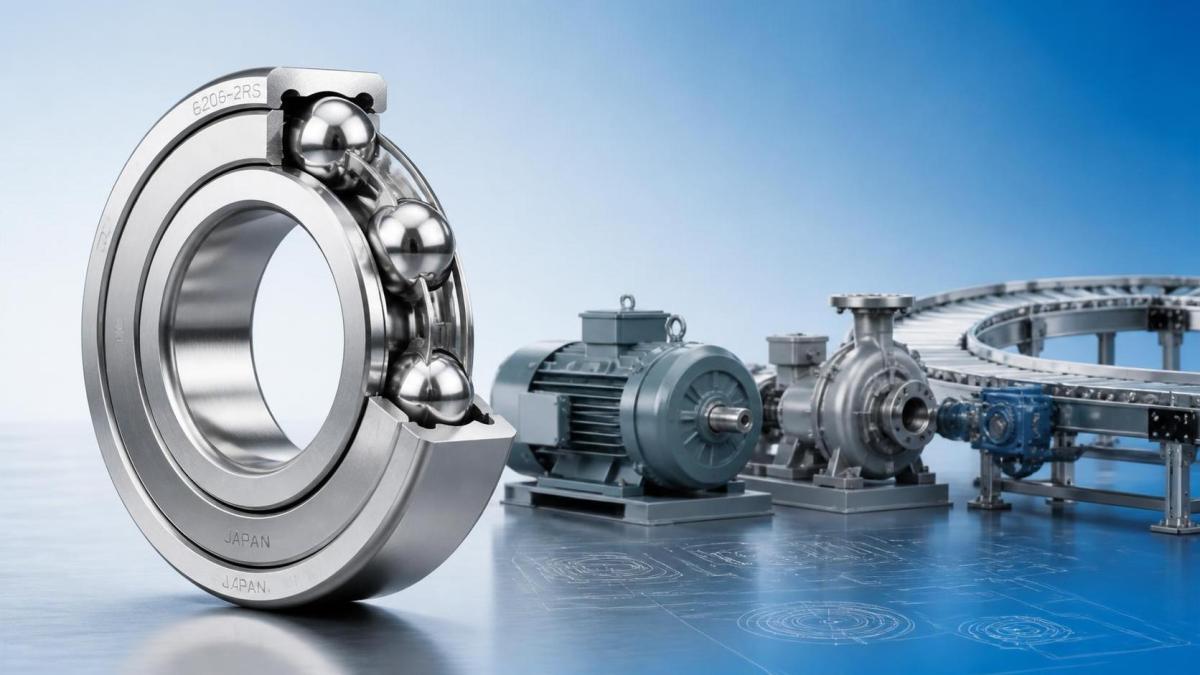
Common designs you may encounter
Not all deep groove ball bearings are identical. Buyers searching for replacements or sourcing for OEM production usually come across several common variations:
- Open type: suitable where external lubrication and controlled environments are available.
- Shielded type: helps protect from dust and light contamination while allowing relatively low running torque.
- Sealed type: better for dirt, moisture, and maintenance reduction in general industrial conditions.
- Single-row type: the most widely used standard configuration.
- Double-row type: useful when higher load capacity is needed within limited installation space.
There are also insert bearing styles used in housed bearing units. While they differ slightly in mounting and application, buyers often evaluate them alongside deep groove ball bearing solutions because the operating needs overlap in many rotating systems.
What makes them attractive in industrial use
If you ask engineers why they continue to rely on deep groove ball bearings, the answer is rarely just “because they are common.” Their real value comes from a combination of practical advantages.
They operate with low friction, which supports higher rotational speeds and helps control temperature rise. Their structure is compact, so machine designers can save space without sacrificing basic load performance. They are also available in many dimensions, precision classes, internal clearance options, and sealing configurations, which makes them flexible for both general machinery and more demanding assemblies.
For maintenance teams, another advantage is predictability. Deep groove ball bearings are well understood globally, replacement dimensions are standardized in many series, and installation practices are familiar across industries. That lowers the risk of procurement mistakes when equipment downtime is costly.
Where selection mistakes usually happen
Although the bearing itself is simple, selection errors are common. One frequent misunderstanding is assuming that size alone determines suitability. In reality, operating speed, load direction, contamination level, lubrication method, fit tolerance, and clearance class can all affect service life.
For example, a buyer may order a bearing with the correct bore and outer diameter but overlook internal clearance. In high-temperature or high-speed conditions, that oversight can lead to unwanted preload, noise, or premature wear. Likewise, choosing an open bearing for a dusty agricultural or conveying environment may save money at purchase but create avoidable maintenance issues later.
Precision grade matters too, especially in applications with speed, vibration, or rotational accuracy requirements. General industrial equipment may work well with standard tolerance classes, while more sensitive machinery may need tighter control.
How to evaluate a deep groove ball bearing before buying
When comparing suppliers, it helps to move beyond catalog photos and focus on decision points that affect actual performance:
- Application conditions: What are the speed, load, temperature, and contamination risks?
- Material quality: Bearing steel quality influences fatigue resistance and dimensional stability.
- Precision and clearance options: Availability of P0, P6, P5, or other grades can matter for different equipment levels.
- Sealing or shielding: This affects lubrication retention and protection against debris.
- Supply consistency: Especially important for importers, distributors, and OEM buyers managing repeat orders.
At Jinan Lanyu, the bearing business is built around import and export trade across product categories including deep groove ball bearings, self-aligning ball bearings, and cylindrical roller bearings. For many international buyers, this matters because sourcing decisions are not only about one bearing model, but about whether a supplier understands application diversity and can support different product lines under one procurement process.
A practical example from adjacent bearing applications
In some mounted or housed systems, buyers may compare deep groove concepts with insert bearing solutions depending on installation style. One example is the INA GAY50-NPP-B Insert Ball Bearing, which features a 50 mm bore, 90 mm outer diameter, and 43 mm width. Built with chrome steel GCr15 and PA66 cage-related material, it is available in multiple precision grades such as P0, P6, P5, and P4, along with clearance options including C2, C0, C3, C4, and C5.
This kind of specification range reflects what many serious buyers look for in bearing sourcing overall: not just one size, but the ability to match precision, clearance, and application requirements more closely. Even when the final choice is a standard deep groove ball bearing rather than an insert type, the same evaluation logic applies.
When deep groove ball bearings are the right choice
They are usually the right fit when the equipment needs high-speed, low-noise, low-friction rotation under mainly radial load, with some axial load capacity. They are especially effective in motors, fans, pumps, light and medium industrial gear systems, agricultural machines, and general mechanical equipment.
They may not be the best option if the application involves very heavy shock load, severe misalignment, or extreme axial load that calls for a more specialized bearing arrangement. In those cases, buyers often need to compare against self-aligning ball bearings or cylindrical roller bearings, depending on the operating challenge.
Final thoughts for buyers and engineers
A deep groove ball bearing is easy to describe, but choosing the right one is more than a vocabulary exercise. It is a decision that affects machine stability, maintenance frequency, energy use, and replacement cost over time. The most successful sourcing decisions usually come from understanding both the bearing’s basic structure and the real operating conditions behind the application.
For distributors, OEM purchasers, and maintenance professionals, that means asking better questions before placing an order: What load does the bearing truly see? What contamination is present? What precision level is necessary? Which clearance will remain appropriate after installation and temperature change? Those details often separate a routine purchase from a reliable long-term solution.
In a market full of interchangeable-looking part numbers, practical knowledge still matters. And when it comes to modern rotating equipment, few components reward that knowledge more consistently than the deep groove ball bearing.
Navigation
Send Us A Message
consult

Jinan Lanyu Import & Export Co., Ltd. is a bearing manufacturing enterprise specializing in the import and export trade of bearings. Covering a total area of 50,000 square meters, the company boasts an annual production capacity exceeding 20 million sets and is dedicated to the manufacture of high-quality bearings.

First class quality service and professional after-sales team.
Get in Touch
*We respect your confidentiality and all information are protected.
