


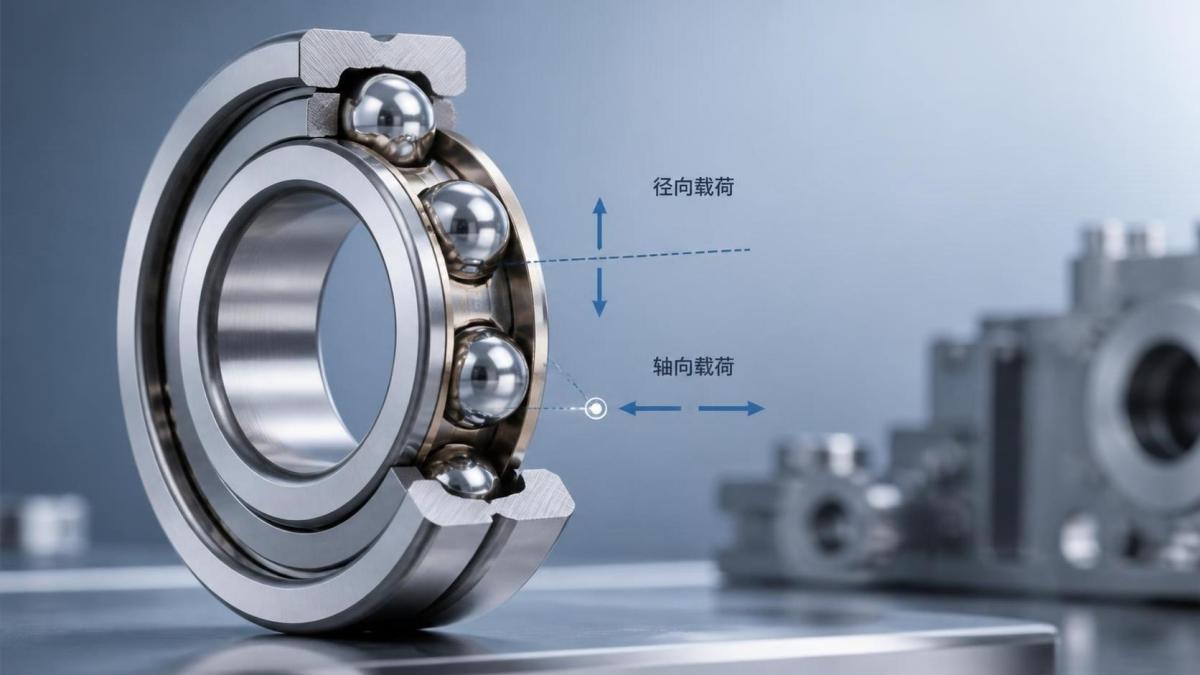
Deep groove ball bearings work by carrying load through a set of hardened steel balls that roll between an inner ring and an outer ring. Each ring has a deep raceway groove, and that groove geometry is the reason the bearing can support radial load efficiently while also taking a certain amount of axial load in both directions. When the shaft turns, the inner ring rotates with it, the balls roll instead of sliding, and the cage keeps the balls evenly spaced so friction, heat, and metal-to-metal contact stay under control.
The basic principle sounds simple, but the actual running behavior depends on contact angle, internal clearance, lubrication condition, speed, and fit between the bearing and its housing or shaft. A deep groove ball bearing is designed so the ball contacts the raceway at a small area rather than a broad sliding surface. That reduces rolling resistance and allows high rotational speed. At the same time, because the grooves are relatively deep and closely conform to the ball curvature, the balls remain guided under combined loading instead of drifting or skidding easily.
What happens inside the bearing during rotation
As rotation begins, the inner ring transmits motion to the balls through the raceway contact points. The balls roll along the raceways, and the outer ring either stays stationary or rotates more slowly depending on the machine layout. The cage does not carry the main working load; its job is to separate the balls, prevent collision, and maintain stable spacing. If the cage deforms, wears, or loses lubrication, the bearing may still turn for a short period, but noise, temperature, and vibration usually rise quickly.
Under pure radial load, the load zone forms over part of the circumference, not around the entire bearing. Only some balls carry the main load at any moment. As the bearing rotates, that load passes from ball to ball. Under axial load, the contact position shifts within the groove, which is why deep groove ball bearings can handle moderate thrust in addition to radial force. They are not a replacement for angular contact or thrust bearings when axial load is dominant, but they perform well in many motors, pumps, fans, gearboxes, and general machinery where loading is mixed and space is limited.
Heat generation follows the same internal logic. If lubrication film thickness is sufficient, the rolling contacts remain separated by a very thin oil layer. If lubrication is insufficient, contamination is present, or the fit is too tight, local friction increases and the raceways can suffer smearing, discoloration, or early fatigue. Many field failures described as “poor bearing quality” are actually installation or operating condition problems.
Why the deep groove matters
The groove profile is central to performance. A shallow groove would not guide the balls securely at speed or under axial displacement. A deep groove keeps the rolling elements in a more controlled path and improves load distribution. That is also why dimensional accuracy and surface finish matter so much during manufacturing. Raceway grinding, ring hardness, ball grade, and roundness affect noise, torque variation, and service life more than the bearing’s outer appearance ever will.
In common production practice, rings and balls are often made from bearing steel such as high-carbon chromium steel. After heat treatment, the material needs enough hardness to resist rolling contact fatigue while retaining dimensional stability. If hardness is uneven, the load zone may develop premature indentations or spalling. If the raceway finish is rough, lubricant film formation becomes less stable and the bearing may run hot even when nominal clearance looks correct.
Clearance, fit, and preload are often misunderstood
Internal clearance is the small amount of free movement between rings before mounting and operation. Once the bearing is pressed onto a shaft or into a housing, that clearance changes. Thermal expansion changes it again. A common mistake is selecting clearance from a catalog without considering interference fit, shaft temperature, or housing material. In a motor running hot, a normal clearance bearing can become too tight after mounting, which increases torque and can shorten life. In another setup with lighter fits and lower temperature, extra clearance may cause vibration, noise, and poor running accuracy.
This is why clearance classes such as C2, C0, C3, C4, and C5 exist. Precision grades also matter when runout, speed, or noise limits are strict. In a mounted bearing unit used around an 80 mm shaft, for example, a product such as SKF UCT216 Radial Insert Ball Bearing Housing Unit may be specified with multiple precision grades from P0 to P4 and different clearance options depending on alignment condition, load pattern, and thermal behavior. The point is not the model name itself, but the fact that bearing selection is tied to the real assembly environment rather than only the nominal dimensions.
Lubrication does more than reduce friction
Grease or oil forms a separating film, protects against corrosion, carries away some heat, and helps exclude contamination. For many deep groove ball bearings in sealed or shielded form, grease fill is chosen for practical maintenance intervals. Too little grease can leave contact areas unprotected. Too much grease is also a problem, especially at high speed, because churning raises temperature. The right fill level depends on speed factor, bearing size, seal design, and housing volume.
Oil lubrication becomes relevant when speed is high, heat must be dissipated, or the bearing shares a lubrication circuit with gears. Viscosity cannot be chosen casually. If the oil is too thin at operating temperature, film strength may be inadequate. If it is too thick, drag losses rise and startup becomes harder. Contamination control is equally important. Small particles can dent raceways and create a repeating vibration pattern long before visible damage appears.
Installation has a direct effect on how the bearing works later
A deep groove ball bearing is sensitive to mounting force path. Pressing on the outer ring to install a tight fit on the shaft sends force through the balls and can mark the raceways before the machine even starts. The correct method applies force only to the ring being fitted. Heating the bearing for mounting can be appropriate within controlled limits, but uneven heating or open flame should be avoided because it may affect material properties or distort dimensions.
Housing bore accuracy, shaft shoulder squareness, and cleanliness during assembly matter as much as the bearing specification. If the shaft seat is out of tolerance, ring creep can occur. If the housing shoulder is not square, the bearing may sit tilted, creating edge stress and abnormal noise. Misalignment tolerance in deep groove ball bearings is limited, so they should not be expected to absorb installation errors that belong elsewhere in the machine design.
Typical operating problems and what they usually mean
- A smooth humming sound that gradually becomes rough often points to lubricant degradation, contamination, or raceway fatigue beginning in the loaded zone.
- Sharp temperature rise soon after startup usually suggests excessive preload, wrong fit, excess grease, or seal drag that was underestimated.
- Regular vibration peaks can come from brinelling, denting by debris, or geometric errors in adjacent components rather than the bearing alone.
- Rust-colored staining may indicate moisture ingress or poor storage conditions before installation, not necessarily a failure generated during operation.
Transport and storage also influence later performance. Bearings left unsealed in humid environments, handled without basic cleanliness, or mixed with incompatible preservatives can develop problems that remain hidden until the first run. Even a well-made bearing may perform badly if the package was opened too early in a dusty workshop or if the mounted unit waited too long before commissioning.
In practical terms, deep groove ball bearings work well because the design converts sliding friction into controlled rolling contact within a compact geometry. When the material, clearance, lubrication, mounting fit, and operating load are aligned, they run quietly and efficiently. When one of those conditions is off, the bearing still turns, but it is no longer working in the way it was designed to work.
Navigation
Send Us A Message
consult

Jinan Lanyu Import & Export Co., Ltd. is a bearing manufacturing enterprise specializing in the import and export trade of bearings. Covering a total area of 50,000 square meters, the company boasts an annual production capacity exceeding 20 million sets and is dedicated to the manufacture of high-quality bearings.

First class quality service and professional after-sales team.
Get in Touch
*We respect your confidentiality and all information are protected.
