


Start with the spindle, not the catalog line
When buyers look at the SKF 7008CEHCP4A Angular Contact Ball Bearing, the mistake is usually the same: they begin with the bearing code and only later ask what the spindle actually needs. For high-speed service, that order causes trouble. A spindle bearing that looks correct on paper can still create heat, preload instability, or short service life if the operating window is not defined early.
A better purchasing check starts with four basic facts from the equipment side: shaft size, housing arrangement, target speed, and load pattern. If the machine team cannot give you those clearly, pause there. You do not need a long technical report, but you do need enough information to tell whether this bearing fits the spindle concept or whether you are forcing a precision bearing into the wrong job.
What to verify before you approve SKF 7008CEHCP4A
For procurement teams sourcing high-speed spindle components, the real value is not finding a famous model number. It is making sure the bearing’s precision, speed capability, and supply condition match the application without creating hidden cost later. That is where an experienced bearing trade partner helps: not by pushing a part number, but by narrowing the risk before the order is placed.
- Check the contact angle requirement. Angular contact ball bearings are chosen for combined radial and axial loads, but not every spindle wants the same balance. If the machine depends on axial rigidity and high rotational accuracy, confirm the designer’s intended arrangement instead of assuming any angular contact bearing will behave the same way.
- Confirm the speed target under actual lubrication conditions. Catalog speed discussions often become misleading when the machine uses a different grease, oil-air, or oil lubrication method than expected. Ask for the lubrication method used in the spindle build, because the practical speed limit depends on that system, not only on the bearing designation.
- Review precision grade expectations in the whole assembly. A high-precision bearing cannot compensate for poor shaft finish, housing error, or loose assembly control. Buyers sometimes spend more on the bearing and then lose the benefit in installation.
- Ask how preload is defined. In high-speed spindle service, preload is not a side detail. It directly affects heat generation, stiffness, and running stability. If preload is already fixed by the machine builder, your job is to source exactly to that requirement, not to substitute based only on dimensions.
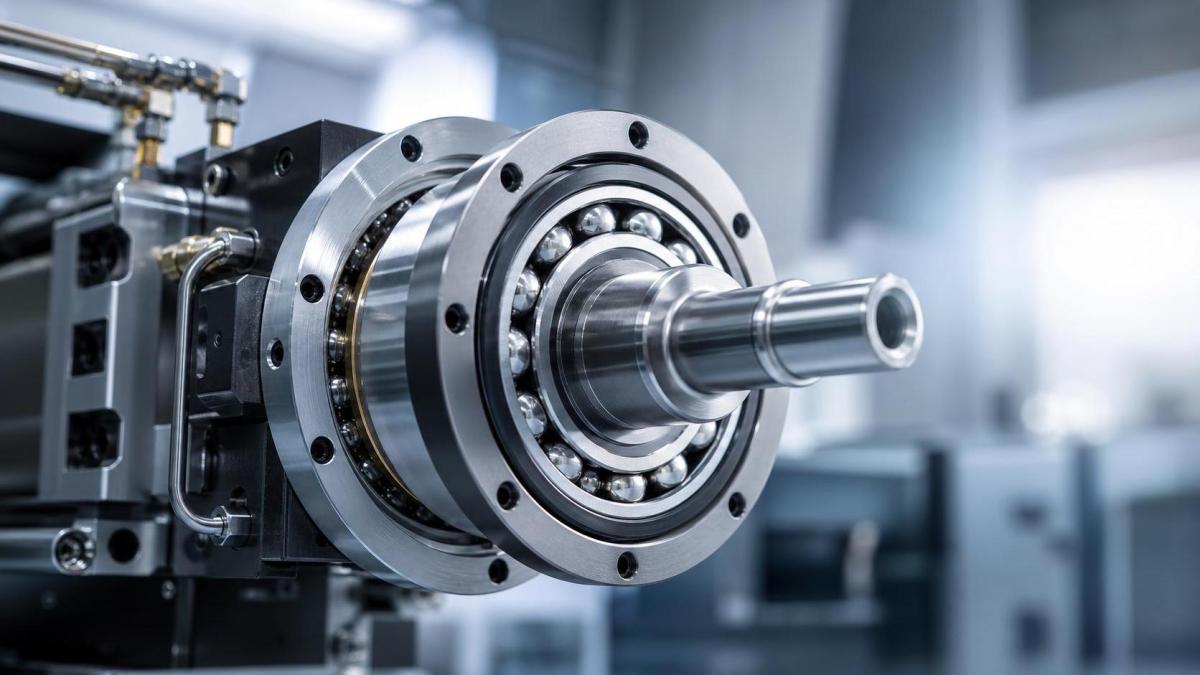
That last point is where many purchasing problems begin. A bearing can be dimensionally interchangeable and still unsuitable if preload class, matching method, or assembly expectation shifts. When the application is a spindle, “close enough” usually turns into extra vibration, warm running, or early replacement.
A practical buyer’s checklist
- Get the full bearing designation from the approved drawing or parts list. Do not buy from a shortened model reference copied from an old invoice. For spindle bearings, suffix details matter.
- Ask whether the bearing is used singly or as part of a matched set. If the spindle arrangement depends on paired or grouped bearings, replacing one unit alone can disturb the original running condition.
- Confirm operating temperature range. Speed decisions without temperature expectations are incomplete. Heat changes clearance behavior and affects lubricant performance.
- Check contamination risk in the real working environment. Clean spindle rooms and general industrial workshops are not the same procurement scenario. The cleaner the application, the more important handling and packaging discipline become.
- Request documentation that identifies origin and condition. For imported bearing trade, this is part of risk control. You want traceable product identification, not a loose promise that the part is “equivalent.”
- Compare lead time against your maintenance window. High-speed spindle bearings are often not emergency-friendly items. If downtime cost is high, availability can matter as much as unit price.
Notice what is not on the list: chasing the lowest quote first. In this category, the cheapest line item can become the most expensive decision once machine stoppage, reassembly labor, and rejected machining quality are added back in.
Questions worth asking your supplier
If you are comparing sources for the SKF 7008CEHCP4A Angular Contact Ball Bearing, use the conversation to test supply reliability, not just price responsiveness. A capable supplier should be able to answer practical questions cleanly:
A supplier serving industrial bearing trade should also be comfortable discussing adjacent product families when the application moves outside spindle duty. For example, in broader industrial applications where tapered roller bearing geometry is the right fit, a part such as FAG 33211-XL Tapered Roller Bearing may be offered with Chrome steel GCr15, steel cage construction, and selectable precision grades from P0 to P4 with clearance options from C2 to C5. That does not replace a spindle angular contact bearing, but it shows why buyers should evaluate by operating requirement first and bearing family second.
Common buying errors that create avoidable cost
One common error is treating the bearing as a standard commodity because the dimensions are known. High-speed spindle bearings are less forgiving than general-purpose units. A small mismatch in handling, storage, or suffix interpretation can wipe out the benefit of buying a premium brand.
Another is approving substitutes too quickly during a lead-time issue. If a supplier proposes an alternative, the review should go beyond “same size” and cover bearing type, precision level, internal design, and assembly expectation. This is especially important when the original machine has a known thermal balance and proven running behavior.
The third is separating procurement from maintenance feedback. The people installing the bearing often know which jobs run hot, which machines are sensitive to preload variation, and which purchase shortcuts caused repeat failures. Use that information before the next sourcing round. It is one of the fastest ways to improve bearing selection quality without adding complexity.
How to close the decision
If the application is truly a high-speed spindle, close the order only after three things line up: the exact bearing designation on the approved technical document, the lubrication and preload assumptions from the machine side, and the supplier’s ability to provide stable, traceable supply. That sequence keeps the decision grounded in operating reality instead of catalog familiarity.
For buyers, that is the practical path: define the spindle conditions, verify the complete SKF 7008CEHCP4A Angular Contact Ball Bearing specification, then compare suppliers on consistency and delivery discipline. Price still matters, but at the end of the process, not at the beginning.
Navigation
Send Us A Message
consult

Jinan Lanyu Import & Export Co., Ltd. is a bearing manufacturing enterprise specializing in the import and export trade of bearings. Covering a total area of 50,000 square meters, the company boasts an annual production capacity exceeding 20 million sets and is dedicated to the manufacture of high-quality bearings.

First class quality service and professional after-sales team.
Get in Touch
*We respect your confidentiality and all information are protected.
