


Choosing deep groove ball bearings sounds simple until a machine starts running hot, making noise, or failing earlier than expected. In practice, the “right” bearing depends on more than just matching dimensions. Load direction, operating speed, sealing requirements, lubrication conditions, and the working environment all shape the final decision. For buyers, maintenance teams, and equipment manufacturers, a careful selection process can prevent costly downtime and improve reliability over the long term.
Deep groove ball bearings are among the most widely used bearing types because they are versatile, compact, and suitable for high-speed operation. They can handle radial loads well and also accommodate a certain amount of axial load in both directions. That makes them a common choice for electric motors, pumps, gearboxes, agricultural equipment, conveyors, fans, and many general industrial applications. Yet their wide availability sometimes creates a false sense that any standard bearing will do. That is usually where mistakes begin.
At Jinan Lanyu, where bearing manufacturing and import-export trade are part of daily business, one pattern appears again and again: customers often know the bearing size they need, but they are still unsure about the internal specifications that truly affect performance. Understanding those details is what makes selection more accurate.
Start with the application, not just the bearing number
If you are choosing a deep groove ball bearing only by part number, you may miss the operating realities of the machine. A conveyor in a dusty plant, for example, places very different demands on a bearing than a high-speed electric motor in a relatively clean environment. The housing fit, shaft tolerance, temperature variation, and contamination level all influence bearing life.
Before comparing models, ask a few practical questions:
- What type of load is the bearing carrying: mostly radial, some axial, or both?
- Is the machine running continuously or intermittently?
- What is the operating speed?
- Will the bearing face moisture, dust, vibration, or chemical exposure?
- Is low noise important?
- Will maintenance access be easy or limited?
These questions may seem basic, but they often reveal whether you need an open bearing, a sealed version, a different clearance, or even another bearing type entirely.
Understand load capacity and why it matters
Deep groove ball bearings are excellent for moderate loads, especially when high speed is involved. However, they are not the best answer for every heavy-duty condition. If the application has significant combined loads or shock loading, selecting only by size can lead to deformation, excessive vibration, or shortened service life.
For lighter and medium-duty machinery, deep groove ball bearings are usually an efficient and economical choice. But if the load becomes more demanding, it is wise to compare alternatives. In some cases, a tapered roller bearing or cylindrical roller bearing may provide better support. This is especially relevant for buyers handling multiple industrial applications rather than a single machine category.
That is why many procurement teams working with broad equipment portfolios look beyond one bearing family. Alongside deep groove ball bearings, related products such as TIMKEN SET47 Tapered Roller Bearing may be considered when the load pattern or stiffness requirement changes. With model LM102949/LM102910, chrome steel GCr15 material, and options including P0, P6, P5, and P4 precision grades as well as C2 to C5 clearances, it illustrates how bearing selection often depends on operating demands rather than habit.
Speed capability is not a small detail
One of the biggest advantages of deep groove ball bearings is their ability to run at high speed with relatively low friction. But high-speed performance depends on more than the design itself. Precision grade, cage design, lubrication method, and seal contact all influence actual behavior.
If your application involves motors, fans, or pumps, speed capability should be reviewed carefully. A bearing that handles the load may still underperform if friction increases temperature beyond acceptable levels. In high-speed applications, buyers often pay closer attention to precision consistency, internal clearance, and lubricant compatibility. This is especially important when low noise and smooth rotation are part of the requirement.
When speed rises, temperature follows. That means clearance selection becomes more important too. A bearing with unsuitable clearance may operate too tightly once thermal expansion occurs. On the other hand, too much clearance can affect vibration and running accuracy.
Open, shielded, or sealed: the environment decides
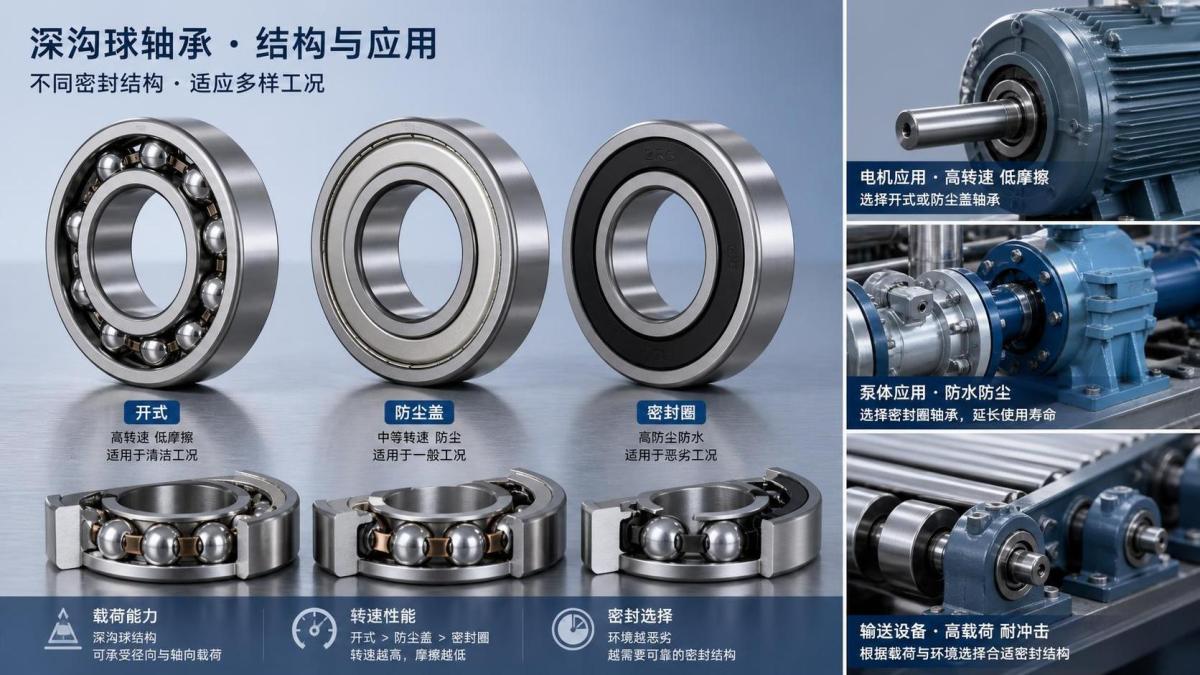
Many purchasing decisions come down to a simple but important trade-off: maximum speed and maintenance flexibility, or better protection against contamination. Open bearings are useful where lubrication is managed externally and the environment is clean. Shielded bearings help reduce the entry of larger particles while maintaining relatively low friction. Sealed bearings are often preferred where dust, moisture, or debris could shorten service life.
In real-world factory conditions, contamination is one of the most common reasons bearings fail early. Fine dust, water ingress, and poor relubrication practices can damage raceways long before the bearing reaches its theoretical life. This is why sealing is not a secondary feature. In many applications, it is central to reliable operation.
For hard-to-reach installations, sealed deep groove ball bearings can reduce maintenance frequency and simplify service planning. For machinery that is cleaned often or used outdoors, the right seal design can make a noticeable difference in durability.
Material and manufacturing consistency affect real service life
Buyers sometimes focus on dimensions and price while overlooking material quality and process stability. Yet steel cleanliness, heat treatment, raceway finish, and dimensional control all influence fatigue life, noise level, and wear resistance.
Deep groove ball bearings used in industrial equipment are commonly made from bearing steel such as GCr15 or equivalent chrome steel. This material offers good hardness and wear performance when processed correctly. But material alone is not the full story. Manufacturing consistency matters just as much, especially for export buyers and OEM customers who need predictable quality across repeated orders.
That is one reason experienced sourcing teams ask about precision grades, clearance options, and application matching rather than choosing solely on unit cost. A lower purchase price can become expensive if it increases maintenance intervals or causes line stoppages.
Internal clearance and precision grade are often misunderstood
Not every buyer needs advanced technical detail, but understanding the basics of clearance and precision can prevent poor matching. Internal clearance refers to the internal looseness between rolling elements and raceways before installation. Common options such as C2, C0, and C3 are chosen based on fit, temperature, and running conditions.
C3 clearance, for example, is often selected where higher operating temperature or tighter shaft fits are expected. Standard clearance may be sufficient for general-purpose equipment. Choosing incorrectly can lead to excess heat, noise, or instability.
Precision grade is another factor. General industrial applications may work well with standard accuracy, while high-speed or vibration-sensitive machines may require tighter tolerances. The decision should reflect actual operating needs, not simply a desire for the “highest” grade available.
Common selection mistakes to avoid
- Choosing only by dimension without checking load and speed conditions
- Ignoring contamination risks in dusty or wet environments
- Selecting the wrong clearance for thermal expansion or fit conditions
- Using open bearings where maintenance access is limited
- Assuming all bearings of the same size perform the same way
These mistakes are common because deep groove ball bearings are so familiar. Their popularity can make them look interchangeable, even when application conditions say otherwise.
A practical way to compare options before ordering
If you are evaluating suppliers or preparing an order list, it helps to compare bearings through a short checklist: application type, dimensions, load direction, speed, sealing form, material, clearance, precision, lubrication method, and expected environment. This keeps the conversation focused and reduces back-and-forth during procurement.
For companies involved in international sourcing, supply stability and technical communication also matter. A supplier should be able to clarify whether a standard deep groove ball bearing is suitable or whether another bearing category is a better fit. That kind of guidance is often more valuable than simply receiving a catalog page.
Jinan Lanyu works with customers across different bearing categories, including deep groove ball bearings, self-aligning ball bearings, and cylindrical roller bearings. That broader product understanding helps support selection decisions when an application sits near the edge of what a standard deep groove ball bearing can comfortably handle.
Choose for operating conditions, not convenience
The best deep groove ball bearing is not always the most familiar one, the cheapest one, or even the one currently in stock. It is the one that matches the machine’s real working conditions. When load, speed, sealing, material, and clearance are considered together, bearing selection becomes less of a guess and more of a reliability decision.
For buyers who want fewer failures and smoother equipment performance, that extra attention upfront is well worth it. A well-matched bearing supports not only rotating parts, but also the efficiency of the entire operation.
Navigation
Send Us A Message
consult

Jinan Lanyu Import & Export Co., Ltd. is a bearing manufacturing enterprise specializing in the import and export trade of bearings. Covering a total area of 50,000 square meters, the company boasts an annual production capacity exceeding 20 million sets and is dedicated to the manufacture of high-quality bearings.

First class quality service and professional after-sales team.
Get in Touch
*We respect your confidentiality and all information are protected.
