


When choosing deep groove ball bearings, understanding the differences between open and sealed designs is essential for performance, maintenance, and service life. For importers, distributors, and industrial buyers, the right selection can improve equipment reliability and reduce operating costs. As a bearing manufacturing and export enterprise, Jinan Lanyu provides deep groove ball bearings and other precision bearing solutions to meet diverse application needs.
In practice, the choice between open and sealed deep groove ball bearings is rarely just a technical preference. It affects lubrication strategy, contamination risk, maintenance intervals, inventory planning, and even after-sales claims. Buyers who treat both designs as interchangeable often discover that the real cost difference appears only after the bearing is installed.
Why the distinction matters more than it seems
Deep groove ball bearings are used across motors, pumps, fans, agricultural machinery, household equipment, conveyors, and light industrial systems because they are versatile, compact, and cost-efficient. Yet the same bearing type may behave very differently depending on whether it is supplied open or sealed.
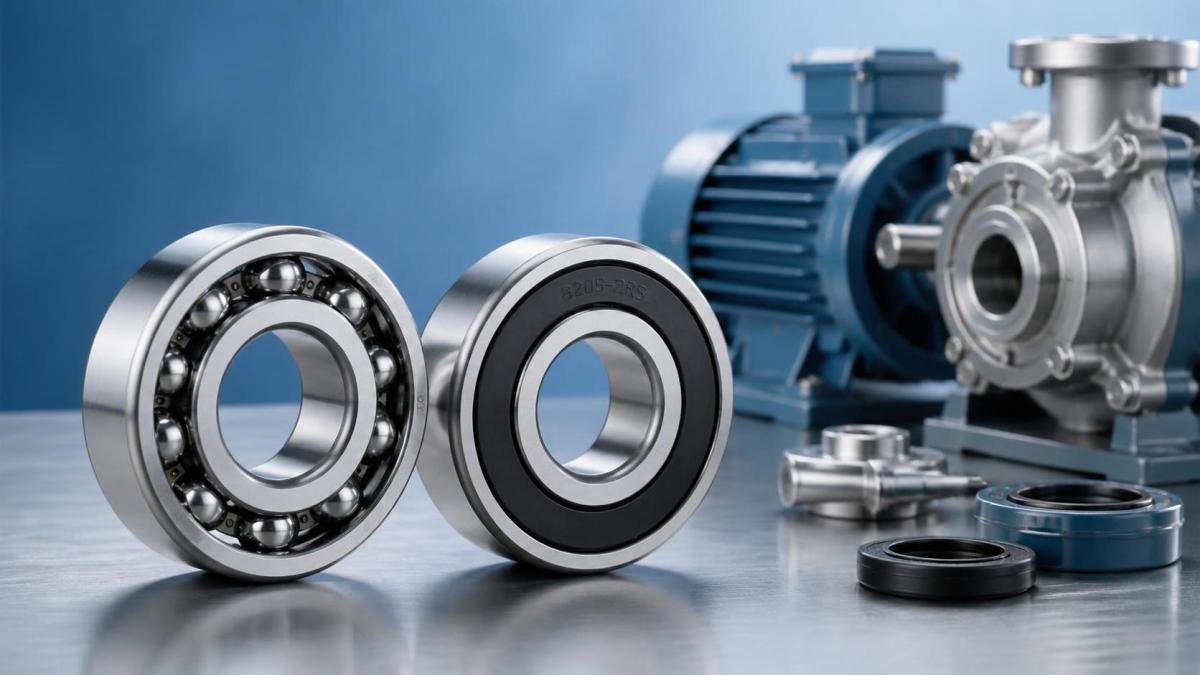
An open bearing has no integrated sealing element. A sealed bearing includes contact or low-contact seals on one or both sides, typically pre-filled with grease. On paper, the distinction looks simple. In real operations, it determines how much the bearing depends on the surrounding housing, lubrication discipline, and environmental cleanliness.
For clean, controlled systems with centralized lubrication, open bearings may be the better engineering choice. For dusty, wet, or maintenance-sensitive equipment, sealed bearings often reduce failure risk more effectively than a lower unit price ever could.
What open bearings do well
Open deep groove ball bearings remain common in industrial applications for good reasons. They allow more flexibility in lubrication selection and replenishment. Operators can choose grease or oil based on speed, temperature, load, and operating cycle. In high-speed equipment or systems with oil circulation, open designs are often more appropriate because they integrate better with the machine’s lubrication architecture.
They also make inspection and relubrication easier in serviceable assemblies. For maintenance teams that already run disciplined lubrication programs, open bearings can deliver long service life at a competitive cost.
Another practical advantage is thermal behavior. In some applications, especially where heat generation and lubricant flow matter, open bearings avoid the drag associated with contact seals. That can be useful in higher-speed electric motors, gear-driven systems, and machine tool subassemblies, although the final decision always depends on the complete operating envelope.
The limitation is equally clear: open bearings rely heavily on the equipment designer and the end user to protect them. If the housing sealing is weak, if grease selection is wrong, or if relubrication intervals slip, bearing life can fall quickly.
Where sealed bearings usually win
Sealed deep groove ball bearings are often the safer commercial choice when operating conditions are uncertain. Their integrated seals help retain lubricant and exclude contaminants such as dust, moisture, fibers, or light chemical splash. In many distribution and export markets, this makes them especially attractive for general machinery, electric motors, fans, small pumps, and agricultural or outdoor applications.
For buyers, one of the biggest benefits is predictability. A sealed bearing reduces dependence on installation-site lubrication quality. That matters when products are sold through multiple channels, installed by different contractors, or exported into markets where maintenance practices vary.
Sealed bearings also support lower routine maintenance. In applications designed around “lubricated for life” operation, they can reduce labor, grease consumption, and the risk of contamination during relubrication. This is often more valuable than the small premium paid at purchase.
Still, “sealed” should not be interpreted as “maintenance-proof” or “universal.” Seal design, temperature limits, grease compatibility, speed factor, and contamination severity all matter. In harsh environments, a standard sealed bearing may still need additional external sealing.
The real decision is about operating conditions, not catalog labels
A common mistake in procurement is asking only whether open or sealed is “better.” The more useful question is: what failure mode are you trying to prevent?
If the main risk is contamination ingress, sealed designs usually deserve priority. If the main risk is lubrication starvation in a high-speed or high-temperature system with engineered oil supply, open bearings may be more suitable. If both contamination and heat are serious concerns, the decision becomes application-specific and often depends on the housing, shaft arrangement, and service interval strategy.
Several factors should be assessed before selecting either design:
- How clean is the operating environment?
- Will the bearing be relubricated in service?
- Is the machine exposed to water spray, dust, pulp, powder, or metal fines?
- What are the speed and temperature ranges?
- How reliable is maintenance execution at the end-user site?
- Is downtime more expensive than the bearing itself?
For importers and distributors, the last two questions are often underestimated. A bearing that is technically acceptable in a factory with strong maintenance discipline may become a warranty problem when sold into fragmented service markets.
Cost comparison: purchase price versus lifecycle cost
Open bearings usually have an advantage in initial price. That can make them attractive for large-volume sourcing, especially where margins are tight. But lifecycle cost often tells a different story.
Sealed bearings can lower the total cost of ownership by reducing grease loss, contamination-related failures, maintenance hours, and premature replacements. In industries where labor costs or downtime are high, that benefit quickly outweighs the unit price difference.
For buyers managing international supply chains, there is another layer: inventory simplification. Sealed bearings are often easier to standardize for broad-use replacement markets. Open bearings may require more application review because lubricant choice and sealing arrangement vary by machine. The broader the customer base, the more commercially useful a robust general-purpose solution becomes.
Misunderstandings that create avoidable failures
One frequent misconception is that a sealed bearing always lasts longer than an open one. Not necessarily. In a well-lubricated, well-sealed, and temperature-controlled system, an open bearing can perform extremely well. The issue is not design superiority in the abstract, but suitability in the actual machine.
Another misconception is that open bearings are outdated. They are not. Many demanding applications still depend on them because integrated seals would limit speed, interfere with lubrication flow, or add unnecessary drag.
There is also a supply-chain misunderstanding: some buyers substitute open and sealed versions based on availability alone. This can be risky. Internal clearance, grease fill, seal type, friction torque, and temperature behavior may all affect performance. Substitution should be reviewed technically, not treated as a simple packaging difference.
What distributors and industrial buyers should verify before ordering
In export and cross-border trade, specification accuracy is often more important than broad product descriptions. Before ordering deep groove ball bearings, buyers should confirm:
- Open, shielded, or sealed configuration
- Seal material and seal contact type where relevant
- Lubricant type and fill condition for sealed versions
- Internal clearance class
- Precision grade if speed or vibration performance matters
- Operating temperature range
- Application environment and expected duty cycle
This approach is not limited to ball bearings. Across the wider bearing market, configuration details increasingly shape reliability outcomes. Even in adjacent categories, such as double-row cylindrical roller bearings used in heavier radial load conditions, buyers routinely compare precision grade, clearance, and sealing arrangement before deciding. A reference example is the SKF NNF5018ADA-2LVS Cylindrical Roller Bearing, supplied in chrome steel GCr15 with multiple precision grades from P0 to P4 and clearances from C2 to C5. While it belongs to a different bearing type, it illustrates the same procurement reality: configuration, not just size, drives performance.
How market expectations are shifting
Across many industrial sectors, buyers are moving toward lower-maintenance and more contamination-resistant solutions, especially where equipment is installed in distributed field environments. This trend tends to support sealed bearing demand in replacement markets, light industrial machinery, and appliances.
At the same time, open bearings remain essential in OEM systems with engineered lubrication and higher operating demands. So the market is not moving from one design to the other universally. It is becoming more segmented. Standardization pressure favors sealed products in some channels, while performance optimization preserves open designs in others.
That is why suppliers and sourcing teams should avoid one-size-fits-all stocking logic. The more diverse the application mix, the more important it becomes to classify demand by service conditions rather than by product family alone.
Choosing correctly means defining the maintenance model
The most practical way to choose between open and sealed deep groove ball bearings is to define who will control lubrication and contamination over the bearing’s life.
If the machine builder or plant operator can reliably manage those variables, open bearings may offer flexibility and performance advantages. If that control is weak, inconsistent, or expensive to maintain, sealed bearings often provide a better risk-adjusted solution.
For industrial buyers, this is not merely a technical specification issue. It is a decision about field reliability, service burden, and customer expectation. The right choice is the one that matches the machine’s real operating environment, not the one that looks simpler in the catalog.
In bearing selection, the design difference between open and sealed is small in appearance but significant in consequences. That is exactly why experienced buyers evaluate it early, not after failure data starts to accumulate.
Navigation
Send Us A Message
consult

Jinan Lanyu Import & Export Co., Ltd. is a bearing manufacturing enterprise specializing in the import and export trade of bearings. Covering a total area of 50,000 square meters, the company boasts an annual production capacity exceeding 20 million sets and is dedicated to the manufacture of high-quality bearings.

First class quality service and professional after-sales team.
Get in Touch
*We respect your confidentiality and all information are protected.
