


When people search for deep groove ball bearing failure causes, they are usually trying to answer a practical question: is this a bearing problem, an application problem, or a maintenance problem? That distinction matters. In many industrial settings, a failed bearing is treated as the part that broke, but the root cause often sits upstream in lubrication practice, shaft alignment, housing tolerance, contamination control, or load assumptions that looked acceptable on paper and failed in actual duty.
For buyers, maintenance teams, and distributors, deep groove ball bearings deserve attention precisely because they are so widely used. Their familiarity can create false confidence. Because they are standard, versatile, and available across many supply channels, users sometimes assume replacement is straightforward. In reality, repeated failure in the same position usually signals that the bearing specification, fit, sealing, grease choice, or operating condition has not been fully matched to the application.
Why deep groove ball bearings fail earlier than expected
Deep groove ball bearings are designed to carry radial load and can also handle a certain amount of axial load. That broad usefulness is one reason they appear in motors, pumps, fans, gearboxes, agricultural machinery, conveyors, and general industrial equipment. But versatility is not the same as immunity. Premature failure often happens when a bearing is asked to work outside the stability window that its internal geometry, clearance, lubrication regime, and sealing arrangement were meant to support.
A common mistake in the market is to blame “quality” first. Quality certainly matters, especially when there are inconsistencies in material cleanliness, heat treatment, dimensional accuracy, or cage performance. But field failures are frequently mixed-cause events. An acceptable bearing can fail early in a poor mounting environment, and a premium bearing can still underperform if contamination ingress or overload is not addressed.
The most common failure causes in actual service
Poor lubrication
Lubrication failure remains one of the most common causes. This does not only mean “not enough grease.” It can also mean the wrong grease viscosity for speed and temperature, incompatible grease during relubrication, over-greasing that creates churning and heat, or grease aging long before the maintenance interval assumed by the user.
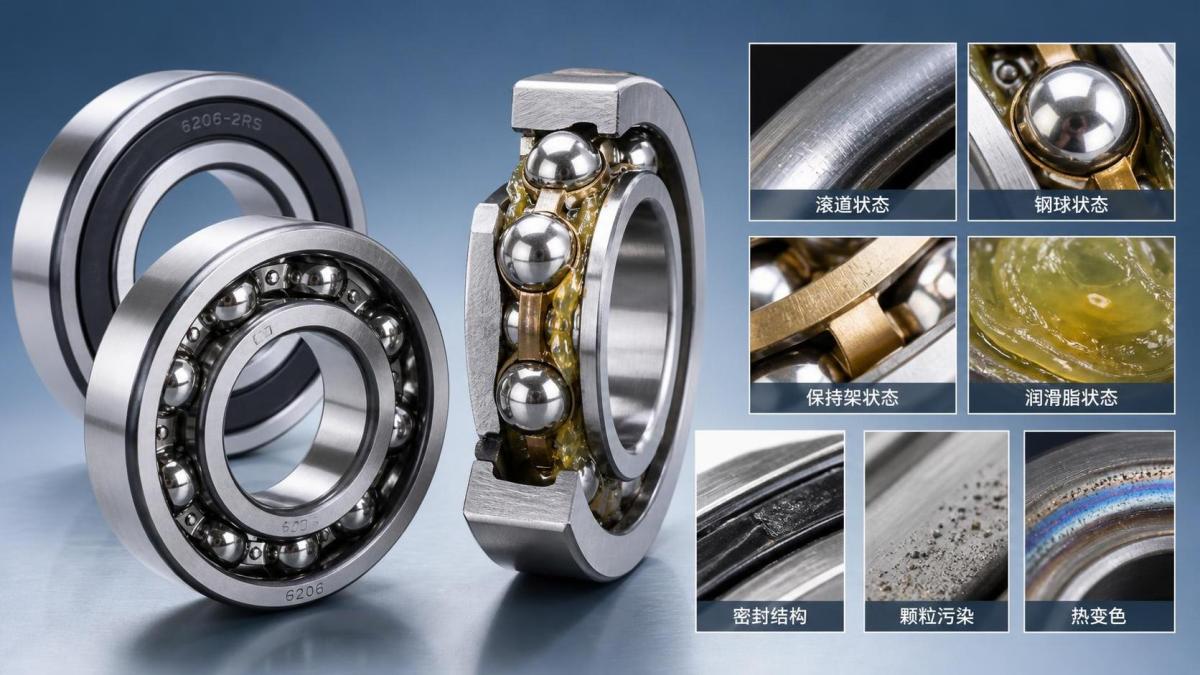
In deep groove ball bearings, inadequate lubrication usually shows up as rising temperature, noise, discoloration, smearing, or raceway wear. In electric motors and continuous-duty equipment, the problem often builds gradually rather than through a sudden breakdown. That is why lubrication-related failures are expensive: by the time the bearing is replaced, the shaft seat, housing, seal surfaces, and adjacent components may already be affected.
Contamination
Dust, metal particles, moisture, and process residue are persistent bearing killers. Even small contamination can interrupt the rolling contact surface and create denting, abrasion, or surface fatigue. In food processing, mining, woodworking, steel, and outdoor equipment, contamination control usually matters more than nominal dynamic load rating in day-to-day reliability.
If a failed bearing shows pitting, dull raceways, embedded particles, or irregular wear, the root cause may be less about the bearing itself and more about seal performance, assembly cleanliness, storage conditions, or the surrounding machine layout.
Improper installation
Installation damage is still underestimated in many procurement and maintenance chains. Force transmitted through the rolling elements during mounting can create invisible early damage. Incorrect fits, hammering, poor heating methods, tilted installation, and failure to check shaft and housing tolerances all shorten life. The bearing may run at first and then fail unexpectedly, which leads some users to misread the issue as a manufacturing defect.
For importers and distributors, this is where after-sales support becomes part of product quality. A bearing supplied into an application with weak installation controls will produce unstable field results regardless of catalog performance.
Overload and load misjudgment
Deep groove ball bearings can accept combined loads, but they are not the right answer for every combined-load condition. In practice, axial load spikes, belt tension changes, impact loads, vibration, and shock from start-stop operation often exceed what the selected bearing arrangement can comfortably absorb. This becomes more serious when the original selection was based on average load instead of real operating peaks.
One useful decision point is this: if the application has significant axial load, higher speed, or a stiffness requirement, the user may need to look beyond a standard deep groove solution. In some machine tool, pump, gearbox, or precision transmission arrangements, Angular contact ball bearings are considered because they can carry radial and axial loads simultaneously, and their axial load capability rises with contact angle. That does not make them a universal replacement, but it shows why root-cause analysis should include bearing type suitability, not just brand or price comparison.
Misalignment and shaft or housing issues
Deep groove ball bearings tolerate only limited misalignment. When the shaft bends, the housing is machined out of tolerance, or the support structure lacks rigidity, load distribution inside the bearing becomes uneven. That increases local stress, heat, and noise. In fan systems, motors, and long-shaft arrangements, this issue is easy to miss because the bearing appears to be the failing part while the actual problem is structural.
Electrical damage and stray current
In motors and inverter-driven systems, fluting or electrical pitting can destroy a bearing that is otherwise correctly selected and lubricated. Maintenance teams sometimes mistake this for ordinary fatigue. The failure pattern is different, and replacement without checking grounding, insulation strategy, or drive-related electrical conditions often leads to repeat failure.
What the failure pattern usually tells you
Experienced buyers and engineers rarely judge a bearing failure by “it seized” or “it got noisy.” The surface evidence matters. Raceway spalling suggests one path; blue discoloration suggests another; cage fracture points to a different stress history; corrosion tells a different story again. The goal is not to overinterpret one damaged part, but to avoid replacing bearings blindly.
What procurement teams should check before reordering the same bearing
Repeat purchasing the same designation after a failure is often the fastest way to continue the same problem. Before reordering, it is worth checking a short list of conditions that sit outside the part number itself:
- Was the actual operating temperature higher than assumed?
- Was the bearing open, shielded, or sealed appropriately for the contamination level?
- Did the application introduce axial load that the original design did not fully account for?
- Were shaft and housing fits confirmed against the duty condition, not just nominal dimensions?
- Was the grease specification aligned with speed, load, and relubrication interval?
- Was the bearing sourced consistently, or did supply vary between factories or quality grades?
For traders and OEM buyers, consistency across batches can matter as much as headline specification. The challenge in global sourcing is that two bearings with similar markings may behave differently in service if there are differences in steel cleanliness, cage material, grease fill, seal design, or internal clearance control. This is where a supplier with stable export experience can reduce risk by clarifying configuration details early rather than treating all standard bearings as fully interchangeable.
When the issue is not failure, but wrong application logic
One of the more expensive misunderstandings in industrial purchasing is assuming that premature failure should always be solved by buying a “better” version of the same bearing. Sometimes the smarter move is to change the arrangement. If the machine faces sustained axial load, higher rotational accuracy requirements, or preload-related stiffness demands, another bearing type may be structurally more suitable. For example, in matched or paired configurations, angular contact designs can support more specific combined-load behavior and tighter rotational control. The point is not to overspecify, but to stop forcing a general-purpose bearing into a duty cycle that has moved beyond general-purpose conditions.
Jinan Lanyu’s position in import and export trade is relevant here in a practical sense: customers often do not need a more expensive bearing first; they need a clearer judgment on whether the failure came from the bearing, the mounting, the environment, or the application load path. That distinction affects not only replacement cost, but lead time, maintenance intervals, and field reliability across the next purchasing cycle.
What to do after a bearing failure
The best next step is usually modest and disciplined: keep the failed bearing, inspect the mating parts, confirm the lubrication record, and compare the actual operating condition with the original selection basis. If there is no clear root cause, changing only the brand is rarely enough. If there is a pattern of contamination, heat, axial load, or repeat installation damage, the solution will likely involve sealing, fit, handling, or bearing type review rather than simple replacement.
Deep groove ball bearing failure causes are rarely mysterious once the application is examined closely. The real cost comes from treating them as isolated part failures when they are often system signals.
Navigation
Send Us A Message
consult

Jinan Lanyu Import & Export Co., Ltd. is a bearing manufacturing enterprise specializing in the import and export trade of bearings. Covering a total area of 50,000 square meters, the company boasts an annual production capacity exceeding 20 million sets and is dedicated to the manufacture of high-quality bearings.

First class quality service and professional after-sales team.
Get in Touch
*We respect your confidentiality and all information are protected.
