


6205 Bearing Price Differences: Comparing Open, ZZ, and 2RS Options
Why does the 6205 bearing price vary between open, ZZ, and 2RS options—even when the bearings share the same dimensions? Shields and seals explain part of the difference, but lubrication, operating conditions, quality requirements, and order volume also influence the quote. For purchasing teams, the useful comparison is not simply which bearing costs less. It is which configuration meets the application requirements without creating avoidable maintenance or replacement costs.
Jinan Lanyu manufactures bearings and specializes in bearing import-export trade, with a core portfolio covering deep groove ball bearings, self-aligning ball bearings, and cylindrical roller bearings. For a standard item such as the 6205, a clear specification is the starting point for comparing supplier offers fairly.
Same dimensions, different protection and lubrication
A standard 6205 deep groove ball bearing has a 25 mm bore, 52 mm outside diameter, and 15 mm width. Open, ZZ, and 2RS versions generally retain these boundary dimensions. That makes them dimensionally interchangeable in many housings, but not automatically interchangeable in service.
The closure changes how the bearing retains grease, excludes contamination, and generates friction. Suffix conventions can also differ between manufacturers, so a quotation should identify the actual shield or seal design rather than relying on the suffix alone.
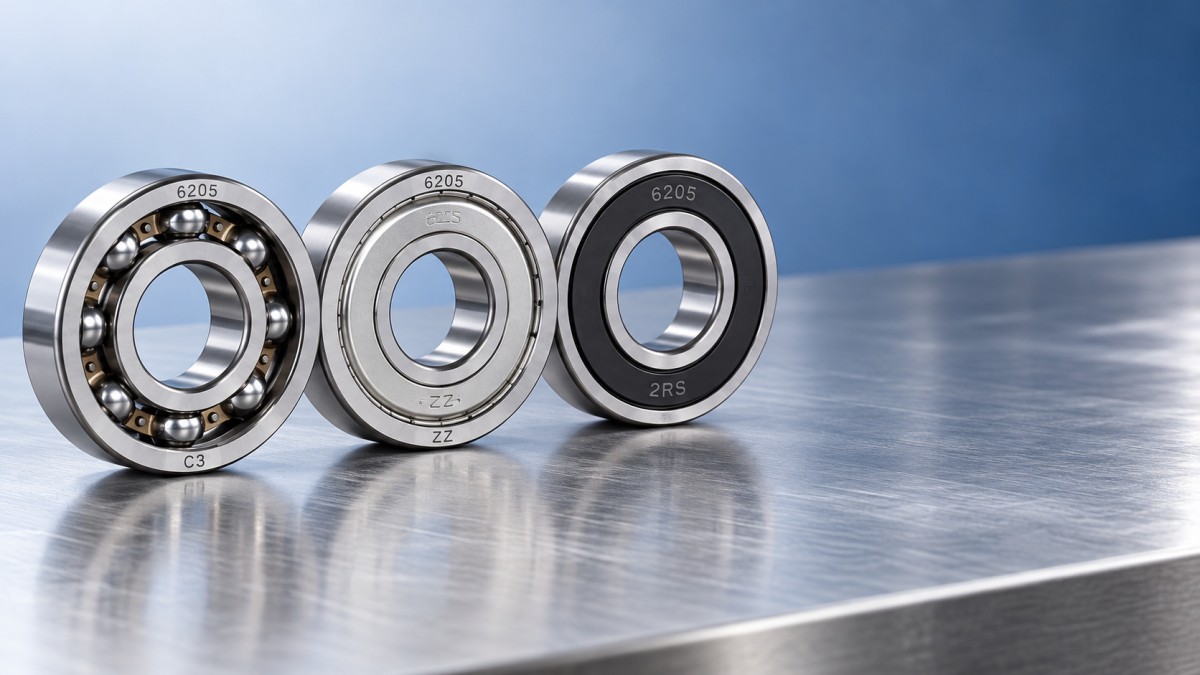
A metal shield is not a waterproof barrier. Likewise, a 2RS bearing should not be assumed suitable for immersion or pressure washing. Where exposure is severe, housing seals and the wider machine design still matter.
Why the cheapest version is not always open
Within the same manufacturer's range, with equivalent materials, accuracy, clearance, and order terms, open bearings often cost less than shielded or sealed versions. Additional closures, grease filling, assembly operations, and inspection can increase manufacturing cost. Contact seals also require controlled materials and geometry to balance sealing performance against friction.
That expected ranking is not a universal price rule. A supplier may hold large stocks of 6205-2RS while producing open bearings only against an order. Stock availability, production quantities, and purchasing agreements can then outweigh the closure cost. Comparing an open bearing from one quality tier with a sealed bearing from another tells you little about the price of sealing itself.
Ask for three matched quotations. Keep the manufacturer, material specification, tolerance class, internal clearance, quantity, packaging, and delivery basis consistent. Then request the lubrication details for each version. Without those controls, the apparent premium may reflect an entirely different specification.
The less visible drivers behind a quotation
Grease deserves more attention than it usually receives. Its operating temperature range, base oil viscosity, compatibility, and fill quantity affect suitability. A special lubricant can alter both price and lead time. “Pre-greased” is not enough information when the bearing will operate continuously, start in cold conditions, or sit near a heat source.
Internal clearance is another common source of mismatched offers. Normal clearance and C3 are not interchangeable purchasing labels. Shaft and housing fits, temperature differences, and operating conditions determine the appropriate choice. C3 should not be treated as an automatic upgrade.
Noise or vibration requirements, dimensional accuracy, traceability, and inspection documentation may also change the quote. If an application needs a particular acceptance test, define the method and limits before ordering. A vague request for “high quality” leaves suppliers pricing different things.
For imported bearings, compare landed cost rather than unit price alone. Freight, packaging, duties where applicable, payment terms, and shipment size can change the outcome. Delivery terms should make clear which costs are included and where responsibility transfers.
Choose around the machine, not the suffix
An open bearing can be economical inside a clean, enclosed assembly with a suitable lubrication system. Buying integral seals in that situation may offer little benefit, particularly if they interfere with the intended lubricant supply. The saving is valid only when the housing and maintenance arrangements already provide adequate protection.
ZZ is often considered where low friction matters and contamination is limited. For motors and similar equipment, check the manufacturer's speed guidance, grease specification, and noise requirements. Shields help retain grease, but fine dust and moisture can still enter through the shield clearance.
A 2RS version is often worth evaluating for exposed or difficult-to-access installations. Better grease retention and contamination exclusion can reduce service demands. However, contact seals add friction and heat, and their material must suit the temperature and surrounding chemicals. Confirm the exact manufacturer's limits rather than applying one speed rating to every 6205.
Also verify the load arrangement before debating closure price. If the assembly requires a dedicated axial bearing, Thrust ball bearings may warrant a separate review. Single-direction designs commonly separate into three pieces, while double-direction designs commonly separate into five. Selection depends on axial load direction and speed; these are not drop-in substitutes for a 6205, and high-speed suitability needs careful checking.
Turn the price comparison into a defensible purchase
Total ownership cost includes the bearing, installation labor, lubrication work, replacement access, and downtime exposure. A lower-priced open bearing may be the right purchase in a protected system. The same bearing can become expensive if contamination causes repeated interventions. Conversely, paying for stronger sealing offers little value if the selected seal cannot tolerate the operating conditions.
Before approving a 6205 bearing price, send suppliers a short, consistent RFQ covering:
- Configuration, clearance, tolerance class, and any noise requirements.
- Operating speed, temperature, contamination exposure, and lubrication method.
- Grease specification and seal material where relevant.
- Quantity, packaging, required delivery date, and delivery terms.
- Required inspection records, traceability, and substitution approval rules.
When requesting alternatives from Jinan Lanyu or another supplier, ask which specifications remain identical and which change. Any proposed substitution should be approved against the machine requirements—not accepted because the dimensions match. That distinction makes the price comparison useful and prevents a small purchasing saving from becoming a maintenance problem.
Navigation
Send Us A Message
consult

Jinan Lanyu Import & Export Co., Ltd. is a bearing manufacturing enterprise specializing in the import and export trade of bearings. Covering a total area of 50,000 square meters, the company boasts an annual production capacity exceeding 20 million sets and is dedicated to the manufacture of high-quality bearings.

First class quality service and professional after-sales team.
Get in Touch
*We respect your confidentiality and all information are protected.
