


What actually matters when choosing a deep groove ball bearing supplier
Finding a reliable deep groove ball bearing supplier sounds simple until a shipment arrives with unstable quality, inconsistent markings, or lead times that keep moving. In bearing trade, the problem is rarely just price. The real issue is whether the supplier can deliver the same product standard, batch after batch, with paperwork, packaging, and communication that match your market requirements.
Deep groove ball bearings are widely used because they fit a broad range of applications: motors, pumps, agricultural equipment, gearboxes, fans, conveyors, and light industrial machinery. That also means buyers often underestimate the sourcing risk. A bearing that looks correct on paper can still fail early if material stability, heat treatment, grease selection, clearance, or sealing execution are not aligned with the actual operating condition.
For importers and distributors, supplier selection should start with one practical question: can this company support your business after the first order, not just win it?
Do not begin with quotation sheets alone
Many buyers compare ten suppliers using only model number, unit price, and delivery promise. That works for very simple replenishment purchases, but it is weak for long-term sourcing. With deep groove ball bearings, differences often hide in internal process control rather than in external dimensions. Two suppliers may both offer the same bearing designation, yet differ in steel source, raceway finishing consistency, radial clearance control, noise performance, or grease filling practice.
A useful quotation review should include more than FOB or CIF price. Ask what tolerance level is being supplied, what clearance class is standard, whether open, ZZ, or 2RS versions are available, and how the supplier handles batch traceability. If the answer is vague, you are not really comparing equivalent offers.
Check whether the supplier understands applications, not just catalog numbers
A good supplier does not simply say “we can provide 6204.” They ask where it will run, at what speed, under what load, and whether dust, moisture, or temperature are concerns. This matters because deep groove ball bearings are general-purpose, but not one-size-fits-all in performance terms.
For example, electric motor buyers may care more about vibration and noise stability. Agricultural equipment buyers usually worry about contamination and sealing. Distributors serving maintenance markets often need flexibility across clearance classes and shield or seal options. A supplier with real export experience will usually ask these questions early, because returns and claims are expensive for both sides.
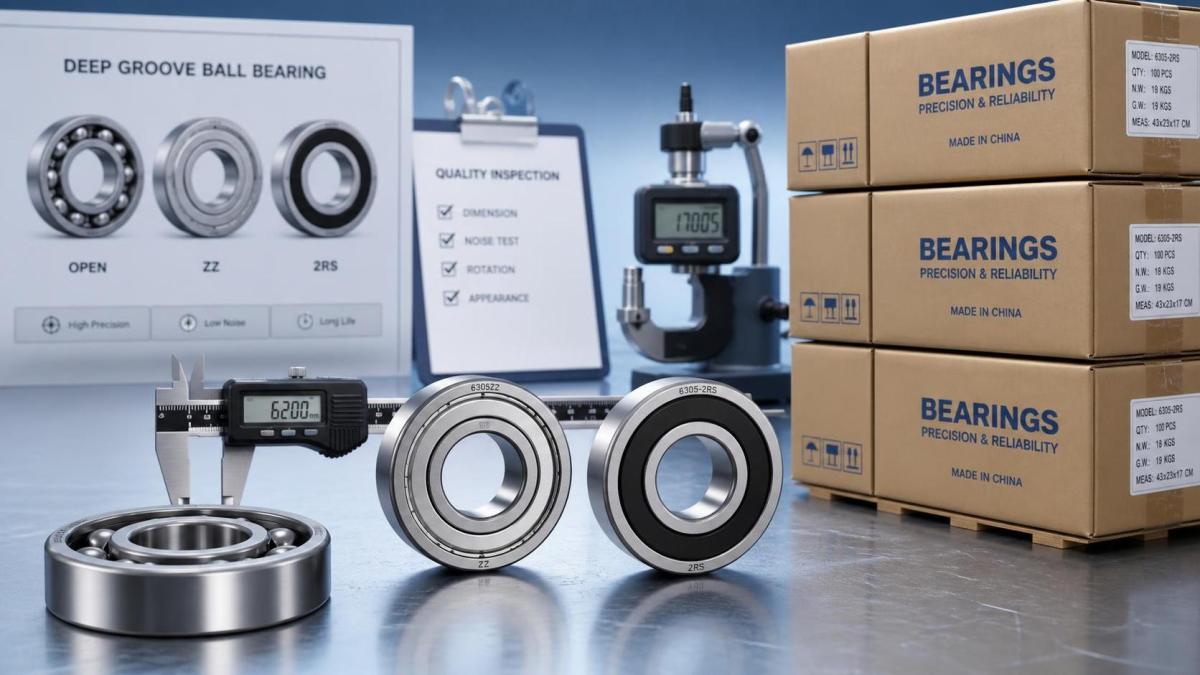
This is also why product range matters. A company focused only on one bearing family can be fine for a narrow program, but in real distribution business, orders often expand. Jinan Lanyu, for instance, works in bearing manufacturing and import-export trade with a portfolio that includes deep groove ball bearings, self-aligning ball bearings, and cylindrical roller bearings. That kind of range can be useful when a buyer wants to consolidate sourcing instead of managing several vendors for adjacent product lines.
Look at manufacturing discipline and export discipline separately
Some factories can make bearings, but cannot support international trade smoothly. Others are good trading companies, but have limited control over production consistency. The right choice depends on your model, but you should know which one you are dealing with.
Manufacturing discipline shows up in process consistency, dimensional control, and the ability to keep specifications stable over repeat orders. Export discipline shows up in document accuracy, packaging protection, labeling, communication speed, and the ability to handle mixed models, container planning, or urgent replenishment. Buyers often focus on the first and discover the second too late.
A supplier worth considering should be able to explain how it manages standard items versus customized requirements. Even a small deviation in grease type, cage design, or clearance can matter in the field, especially when your downstream customer is replacing an OEM-approved bearing with an aftermarket one.
Ask for evidence that fits the job
Not every order needs the same level of technical review. If you are buying standard stock for common industrial circulation, a sample inspection and specification confirmation may be enough. If the bearings are going into higher-speed or more sensitive assemblies, then you may need a closer conversation around precision grade, clearance, material, and operating condition.
In that context, it is normal for a supplier to offer related bearing types with different parameter choices. For example, NSK 7201AW Angular Contact Ball Bearing is not a deep groove model, but it illustrates what a technically prepared supplier should be ready to discuss: 12 mm bore, 32 mm outer diameter, 10 mm width, chrome steel GCr15, and available precision grades from P0 to P4 with clearance options from C2 to C5. Even if your main requirement is deep groove ball bearings, a supplier that can speak clearly about such distinctions usually handles specification work more seriously.
Red flags that experienced buyers notice early
A few warning signs come up again and again in bearing sourcing:
- The supplier avoids confirming tolerance, clearance, or sealing details in writing.
- Prices change sharply once packaging, branding, or inspection requirements are mentioned.
- Sample quality and mass order quality seem disconnected.
- Lead times are promised too quickly for every item, regardless of quantity or model mix.
- Technical questions are answered with generic catalog language instead of direct responses.
None of these points automatically disqualifies a supplier, but taken together they usually indicate weak control somewhere in the chain.
Why communication quality is part of product quality
In international bearing trade, many disputes begin as communication errors. A buyer says “standard clearance,” a supplier assumes C0, but the end use expected C3. A customer asks for neutral packing, then discovers outer cartons still carry old factory marks. Or the inspection standard is discussed verbally and never written into the order confirmation.
This is why the better suppliers tend to be a little more careful, sometimes even slower, before confirming an order. That is not always a bad sign. It usually means they are trying to lock the technical and commercial details before production starts. In bearings, that discipline saves time later.
A practical way to shortlist suppliers
If you are screening several candidates, keep the process simple but strict. Compare them on four things: specification clarity, response quality, supply range, and repeat-order confidence. Price belongs in that review, but not at the top of it.
A supplier with deep groove ball bearings alone may cover today’s need. A supplier that can also support self-aligning ball bearings, cylindrical roller bearings, and related technical discussions may be the better long-term fit if your product mix is expanding. That is often where trading experience and manufacturing understanding meet in a useful way.
In the end, the right deep groove ball bearing supplier is the one who reduces uncertainty. Not the one with the lowest opening number, and not the one with the most polished catalog. Ask better questions, push for written detail, and pay attention to how the supplier handles small technical points. In this industry, small points usually become large costs later.
Navigation
Send Us A Message
consult

Jinan Lanyu Import & Export Co., Ltd. is a bearing manufacturing enterprise specializing in the import and export trade of bearings. Covering a total area of 50,000 square meters, the company boasts an annual production capacity exceeding 20 million sets and is dedicated to the manufacture of high-quality bearings.

First class quality service and professional after-sales team.
Get in Touch
*We respect your confidentiality and all information are protected.
