An overheating Angular Contact Ball Bearing can turn a routine service call into costly downtime. Diagnose the operating conditions before replacing the bearing or restarting equipment.
For maintenance teams, the first question is whether temperature stabilizes within equipment limits or continues rising alongside abnormal vibration, noise, motor current, or lubricant deterioration.
Excessive preload, incorrect shaft or housing fits, and unsuitable lubrication often interact. Correcting only one visible symptom can leave the underlying cause and repeat failures unresolved.
This guide explains how to establish a temperature baseline, inspect mounting conditions, evaluate lubrication, and verify repairs through a controlled restart with documented operating measurements.
Is the Bearing Actually Overheating? Establish the Baseline First
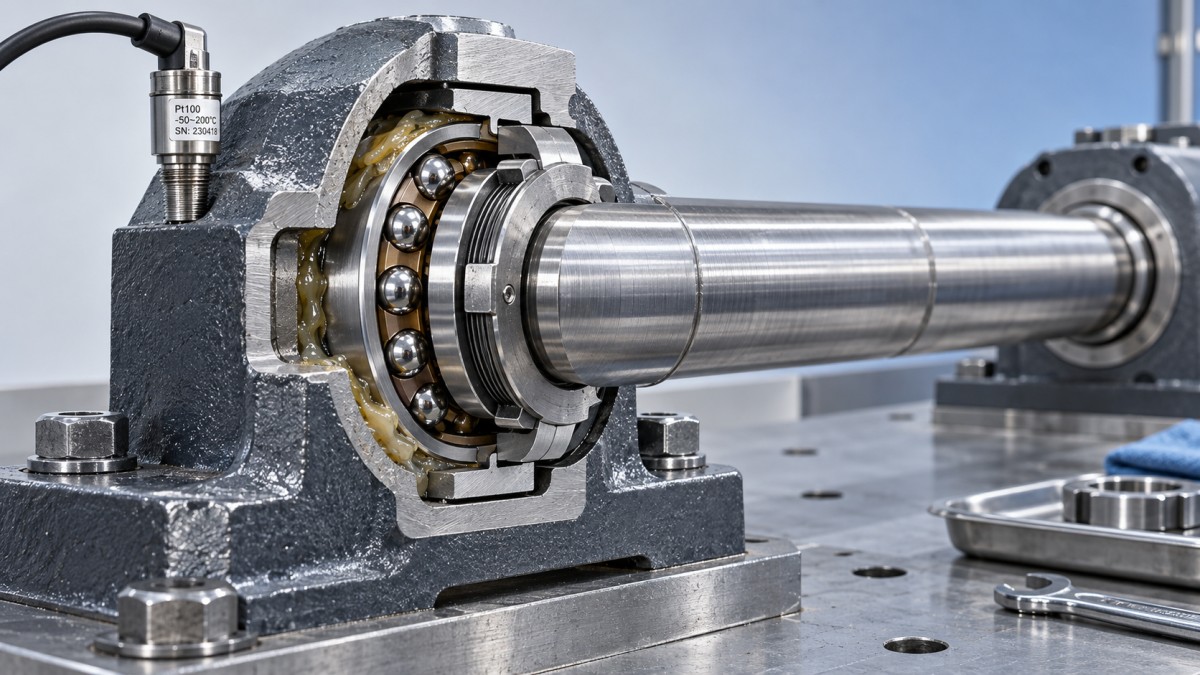
There is no universal temperature limit for every bearing installation. Use the machine manufacturer’s alarm settings, lubricant limits, and bearing specifications to judge acceptable operation.
Measure at a consistent housing location and record ambient temperature, speed, load, and elapsed running time. Housing temperature does not directly equal internal bearing temperature.
When using an infrared thermometer, account for surface emissivity and reflective metal. A suitable contact sensor can improve consistency when comparing readings across service visits.
Compare temperature trends with previous healthy operation under similar conditions. A stable warm housing may be acceptable; a persistent upward trend requires investigation before continued operation.
Stop equipment according to site procedures if temperature exceeds approved limits, rises rapidly, or accompanies severe vibration, smoke, grinding noise, or a sudden current increase.
Before dismantling, isolate energy sources and document recent changes. Bearing replacement, grease replenishment, shaft repairs, higher production speeds, and altered loads can provide valuable diagnostic clues.
Could Excessive Preload Be Creating the Heat?
Preload removes internal freedom and increases stiffness, but excessive preload increases rolling contact forces and friction. The result may be rapid heating despite apparently correct lubrication.
First identify the bearing arrangement: paired single-row bearings, a double-row bearing, or another locating configuration. Their adjustment methods differ, so never apply one preload procedure universally.
For paired bearings, confirm the specified orientation, matched-set markings, spacer dimensions, and preload method. Incorrect assembly can change load sharing or unintentionally increase axial constraint.
Check locknut settings against the equipment procedure. Tightening torque alone does not establish a universal preload value because thread friction, clamping geometry, and assembly design vary.
Where the design permits measurement, compare axial displacement, endplay, or starting torque with specified values. Seal drag and lubricant resistance can affect interpretation of turning torque.
Consider thermal expansion across the shaft, housing, spacers, and bearing arrangement. A setting that appears acceptable when cold can become excessive after the machine reaches temperature.
Do not loosen a retaining nut experimentally while equipment runs. Adjust preload only through the approved procedure, then verify shaft location, retention, and operating behavior.
Are Shaft and Housing Fits Reducing Internal Clearance?
An interference fit can expand the inner ring or compress the outer ring, reducing internal clearance. Excessive interference may therefore create unwanted preload and heat.
Check measured shaft and housing dimensions against the specified tolerances. Include roundness, taper, shoulder squareness, and seating condition; a nominal diameter alone cannot confirm acceptable geometry.
Select fits according to load direction relative to each ring, operating temperature, speed, and application requirements. Neither a loose fit nor heavy interference is universally appropriate.
Inspect for burrs, fretting, damaged shoulders, and rings that have not seated fully. Misalignment or distorted mounting surfaces can concentrate contact loads and raise operating temperature.
Confirm that mounting force passed through the ring being fitted. Force transmitted through the balls can damage raceways, producing noise, vibration, and heating after installation.
Also check whether the arrangement allows its intended axial movement. A floating position that becomes trapped can introduce thermal loading as the shaft and housing expand.
Is Lubrication Reducing Friction or Adding Resistance?
Verify the lubricant against the operating speed, load, temperature, and lubrication system. Base oil viscosity, grease consistency, additives, and compatibility all influence bearing performance during service.
Excessively viscous oil can increase drag, particularly during startup. Insufficient viscosity at operating temperature can weaken the lubricating film and increase contact damage under load.
Too much grease can cause churning and heat, especially at higher speeds. Too little grease, ineffective replenishment, or blocked supply passages can instead produce starvation.
Use the equipment or bearing manufacturer’s filling and replenishment guidance. Avoid assuming that a full housing provides better protection, and account for grease discharge paths.
If overheating began after relubrication, review the quantity added and whether old grease could escape. Check lubricant compatibility before introducing another grease into the housing.
For oil systems, verify actual delivery at the bearing, return flow, filtration, and cooler performance. A normal reservoir level does not prove adequate bearing lubrication.
Inspect accessible lubricant for water, debris, discoloration, or unusual odor. These observations support diagnosis, but laboratory analysis may be needed to distinguish contamination from degradation.
When Replacement Is Necessary, Verify More Than the Model Number
Replace the bearing when inspection identifies damage requiring replacement under the service criteria. Correct the contributing preload, fit, or lubrication problem before installing the replacement.
The listed NSK 5309 Angular Contact Ball Bearing has a 45 mm bore, 100 mm outside diameter, and 39.7 mm width for initial dimensional comparison.
The supplied product information also lists GCr15 chrome steel, a sheet-metal cage, and a weight of 1.29 kg. These details alone do not establish interchangeability.
The 5309 designation generally identifies a double-row angular contact design. Confirm the complete designation and manufacturer documentation before applying installation instructions intended for matched single-row pairs.
Precision grades P0, P6, P5, and P4, plus clearance options C2 through C5, are listed. Confirm actual availability and suitability for the exact supplied variant.
Higher precision does not automatically solve overheating, and greater initial clearance does not automatically correct excessive interference. Selection must account for fits, loads, temperature, and arrangement.
Jinan Lanyu manufactures bearings and specializes in bearing import and export, including deep groove, self-aligning, and cylindrical roller bearings. Provide complete application details when requesting replacements.
How to Confirm the Repair Before Returning Equipment to Service
After reassembly, verify shaft movement, retention, lubrication delivery, and sensor operation. Follow the equipment’s commissioning procedure, increasing speed and load only through permitted operating stages.
Record temperature, vibration, motor current, speed, and load at consistent intervals. Compare the results with approved limits and the healthy baseline established before the failure.
A successful repair should produce acceptable, stable operation under the intended duty. A brief cool run at low speed cannot validate performance at full load.
If temperature rises again, stop at the specified threshold and revisit the interacting causes. Avoid repeated grease additions or preload adjustments without supporting measurements and documentation.
The practical rule is straightforward: confirm the temperature problem, inspect preload and fits, verify lubrication, and validate the repair. Replacement succeeds when the cause is corrected.