


Select angular contact ball bearing preload by finding the lowest setting that maintains the required stiffness and stable bearing contact throughout the spindle’s operating cycle. A heavier preload can improve rigidity, but it also increases contact loads and heat. A lighter setting may support higher speeds, yet leave the spindle vulnerable to tool deflection or unloading under reversing forces.
The decision therefore starts with the spindle’s speed, cutting loads, and thermal behavior—not with a catalog label such as “light” or “medium.” Those labels describe an initial condition for a particular bearing design. They do not, by themselves, establish how the assembled spindle will behave after warming up.
Define the operating conditions before choosing a preload class
Preload creates an internal load between opposed bearings before an external machining load acts. This removes axial clearance and increases resistance to displacement. However, the required preload depends on the complete bearing arrangement and the accuracy expected at the tool.
Build the selection around the operating conditions that place different demands on the spindle:
- Maximum continuous speed: Include how long the spindle remains at that speed, rather than considering only its advertised maximum.
- Cutting forces: Identify radial force, axial thrust in both directions, and the overturning moment created by tool overhang.
- Accuracy requirements: Define acceptable displacement under load as well as running accuracy without load.
- Duty cycle: Account for cold starts, acceleration, interrupted cuts, and transitions between heavy cutting and high-speed finishing.
- Thermal conditions: Include motor heat, bearing lubrication, housing cooling, and the temperature difference between shaft and housing.
A spindle used mainly for light finishing may favor a lighter preload to control heat at sustained speed. A spindle handling substantial cutting forces may need greater rigidity. If one spindle must perform both tasks, evaluate both operating limits; selecting only for the heaviest cut can compromise high-speed operation.
Use the manufacturer’s stiffness and load-displacement data for the actual bearing set. Tool-tip deflection also includes shaft bending, housing flexibility, and toolholder compliance. Increasing preload will have limited value if another part of the assembly dominates the displacement.
Fixed-position or constant-pressure preload?
In a fixed-position arrangement, the relative axial positions of the bearing rings are constrained, commonly through matched bearing faces, spacers, and clamping components. This can provide high assembly stiffness, but dimensional changes affect the internal load. Small differences in spacer lengths, fits, or temperatures can produce a substantial change in preload.
Constant-pressure preload uses springs or another compliant loading mechanism to apply axial force while allowing movement. It can accommodate thermal growth more readily, provided the moving ring can slide freely and the spring has sufficient travel. The applied force is approximately constant over the designed working range; internal ball contact loads still change with speed and external loading.
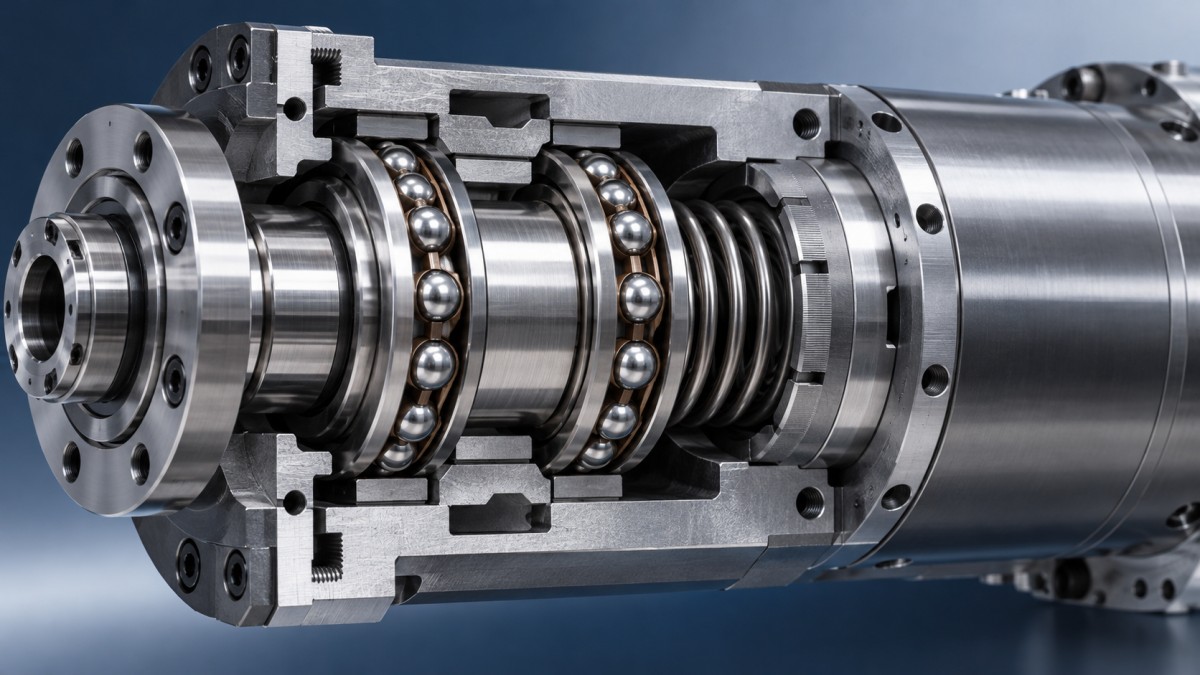
For a spindle dominated by sustained speed and predictable loading, spring preload is a useful candidate. Where tool positioning under variable thrust is the priority, fixed-position preload may be more suitable. Neither arrangement eliminates the need to calculate load distribution and check thermal behavior.
Cold assembly preload is only the starting point
The preload measured or specified during assembly is not necessarily the preload present during machining. Shaft and housing temperatures change at different rates. Inner and outer rings expand differently, and axial growth changes the relationship between bearing supports. Depending on the arrangement, these effects can increase or decrease preload.
In a fixed-position system, excessive operating preload can create a feedback loop: increased contact load produces more heat, thermal expansion changes the geometry, and the resulting preload produces still more heat. A stable temperature at one speed does not establish stability across the full operating range.
High speed also changes bearing behavior through centrifugal effects and changes in contact angle. Use speed-dependent bearing calculations when comparing candidates; a static stiffness value alone cannot represent the conditions at maximum speed.
Lubrication belongs in this assessment. Excess grease or excessive oil delivery can increase drag and temperature, while insufficient lubricant can damage the contacts. Evaluate preload with the intended lubricant, quantity, delivery method, and cooling arrangement. A temperature problem caused by lubrication should not automatically be treated by reducing preload.
Keep bearing geometry and support roles separate
Contact angle influences how an angular contact bearing handles thrust and develops axial stiffness. A larger contact angle generally favors axial load capacity, while high-speed suitability depends on the complete design, including ball size, cage, materials, and lubrication. Contact angle and preload should therefore be selected together.
Arrangement also matters. A back-to-back pair generally offers greater resistance to overturning moments than a comparable face-to-face pair. Tandem bearings share thrust in one direction and require an opposing bearing arrangement for reverse thrust. Bearings within a set need compatible matching and orientation; adding another bearing does not automatically create predictable load sharing.
A separate cylindrical roller bearing may provide radial support elsewhere in the spindle. For example, the NSK NN3024MBKRCC1P4 Radial Super Precision Bearing, listed with a 120 mm bore, 180 mm outside diameter, and 46 mm width, belongs to this radial-support assessment. Its clearance and mounting conditions require their own evaluation; it does not replace an angular contact pair’s axial locating function.
When preparing a bearing inquiry through Jinan Lanyu, whose portfolio includes cylindrical roller bearings, specify the function of each spindle support. Radial clearance classes and angular contact preload classes describe different conditions and should not be treated as interchangeable selection options.
Compare candidates using operating limits, not labels
Preload classes are not universal across manufacturers, bearing sizes, contact angles, or set configurations. Compare the specified preload force, arrangement, and stiffness data for each candidate. The same class name can represent different forces and different spindle behavior.
Begin with the lighter available preload candidates and check whether they meet displacement and contact-stability requirements. Increase preload only where the calculation identifies a stiffness or unloading problem. Then reassess friction, operating temperature, and life under the resulting internal and external loads.
If acceptable rigidity requires a preload that creates excessive heat, reconsider the spindle architecture. Bearing spacing, tool overhang, shaft diameter, or support arrangement may offer a more effective correction. Preload should not compensate for avoidable structural flexibility.
Validate the assembled spindle before releasing the specification
The final choice needs an assembly and operating check. Bearing fits, shoulder alignment, spacer parallelism, and clamping procedures can alter the intended setting. Tightening a locknut harder is not a reliable preload adjustment method: clamping secures the assembly, while preload follows the bearing geometry and loading mechanism.
Use a staged validation sequence:
- Check assembly condition. Confirm bearing orientation, spacer dimensions, ring seating, and unobstructed movement wherever thermal displacement is intended.
- Run in under controlled conditions. Follow the bearing and lubrication system’s run-in procedure while monitoring temperature and vibration.
- Increase speed progressively. Evaluate temperature trends and stabilization rather than relying on one isolated reading.
- Apply representative loads. Check tool-tip displacement, axial behavior, and vibration under relevant cutting conditions.
- Repeat thermal transitions. Include cold starts, warm restarts, and changes between high-speed finishing and heavier cutting.
Persistent temperature rise, increasing vibration, or changing axial position calls for investigation of preload, lubrication, fits, alignment, and cooling together. Record the accepted bearing set, preload specification, mounting dimensions, lubrication conditions, and duty cycle. That turns a successful trial into a repeatable spindle specification.
Navigation
Send Us A Message
consult

Jinan Lanyu Import & Export Co., Ltd. is a bearing manufacturing enterprise specializing in the import and export trade of bearings. Covering a total area of 50,000 square meters, the company boasts an annual production capacity exceeding 20 million sets and is dedicated to the manufacture of high-quality bearings.

First class quality service and professional after-sales team.
Get in Touch
*We respect your confidentiality and all information are protected.
