A standard bearing stops being the most economical choice when it cannot reliably meet operating requirements, and the resulting failures cost more than justified customization.
For technical evaluators, comparing custom and standard deep groove ball bearings requires more than checking dimensions and load ratings. Operating conditions determine which specifications matter.
The deep groove ball bearing price can rise with tighter tolerances, specialized materials, nonstandard seals, or low production volumes. Those premiums require a measurable engineering justification.
This article explains the main cost drivers, shows how to compare supplier quotations, and identifies when an existing catalog option can satisfy the same requirement.
Which requirements actually justify a higher bearing price?
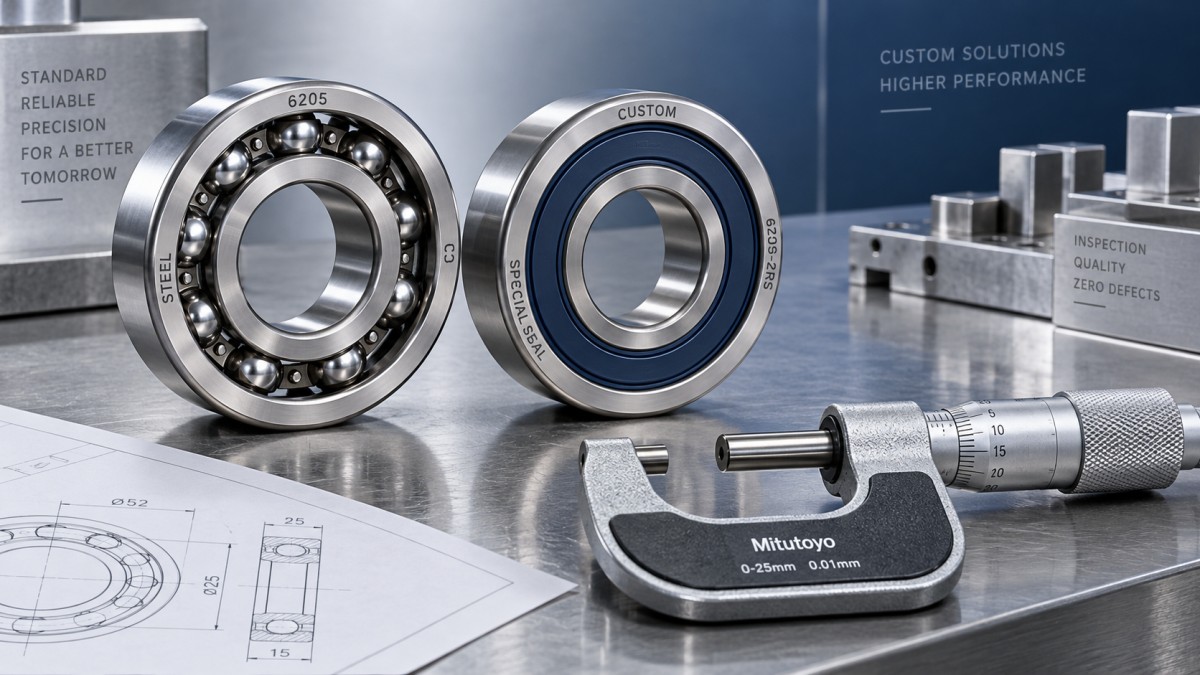
Start with the failure mechanism or performance limit you need to address. A higher specification has value only when it improves that specific operating constraint.
Document radial and axial loads, rotational speed, duty cycle, temperature, contamination, lubrication, shaft fits, housing fits, and acceptable noise or vibration before requesting a quotation.
For example, a bearing exposed to washdown may need better corrosion resistance and sealing. A continuously running motor may prioritize grease life and low friction.
Separate mandatory requirements from preferences. Specify measurable limits, such as operating temperature or permissible vibration, instead of requesting a broadly defined “premium” bearing without acceptance criteria.
Then check the manufacturer's existing range. Different seals, clearance groups, lubricants, or precision classes may already be catalog options, avoiding a dedicated custom production run.
Distinguish availability from customization: an uncommon catalog bearing can carry a premium because of limited stock, even when its design requires no new engineering work.
Where do custom bearing costs increase most?
Nonstandard dimensions and internal geometry
Changes to bore diameter, outside diameter, width, ring features, or internal geometry can require additional engineering, tooling, process development, and inspection beyond routine series production.
A special dimension may also prevent the manufacturer from using existing blanks or grinding setups. These changes become particularly expensive when distributed across small order quantities.
Before changing the bearing envelope, assess whether a shaft sleeve, housing adjustment, or alternative standard series can solve the packaging issue without compromising stiffness or assembly.
Tighter precision and additional inspection
Higher accuracy can increase grinding time, demand tighter process control, and reduce manufacturing yield. The premium grows when inspection must verify additional characteristics for every unit.
However, higher dimensional precision alone does not establish low noise performance. Noise sensitive applications may require separate vibration limits, cleanliness controls, lubricant selection, and testing.
Specify the characteristic that affects performance: running accuracy, dimensional tolerance, vibration, or noise. Avoid requesting the highest precision class merely because it appears technically superior.
Materials, heat treatment, seals, and grease
Alternative steels, coatings, specialized heat treatment, and temperature stabilization may increase material and processing costs. Their value depends on corrosion exposure, temperature, and required durability.
Stainless steel does not automatically provide equivalent load capacity to conventional bearing steel. Confirm the selected material's ratings and operating limits before accepting a substitution.
Special seals and greases can introduce component minimums, sourcing constraints, and compatibility testing. Contact seals may improve contamination exclusion while increasing friction and operating temperature.
Evaluate the complete combination. A suitable grease with an unsuitable seal, or a temperature capable lubricant in an unstabilized bearing, can leave the original problem unresolved.
Why do quantity and documentation change the quotation?
Custom orders often include fixed costs for drawings, tooling, setup, sample production, and qualification. The quantity over which those costs are recovered strongly affects unit pricing.
Ask suppliers to separate recurring unit costs from one-time charges. Otherwise, a high initial quotation may disguise a competitive production price after development expenses are recovered.
Minimum order quantities can create additional inventory costs. A lower unit price offers limited benefit if the order substantially exceeds your realistic consumption and replenishment needs.
Material certificates, lot traceability, dimensional reports, and application-specific testing also add work. Define necessary documentation clearly so competing suppliers quote the same scope of supply.
Lead time deserves equal attention. Dedicated production, imported components, or extended qualification may require more safety stock and increase the operational consequences of delayed deliveries.
Request prices at your expected annual volume and practical release quantities. Confirm whether repeat orders retain the same pricing, tooling access, and agreed inspection requirements.
Can a standard bearing solve the problem first?
Many apparent customization needs originate in bearing selection or installation. Incorrect fits, unsuitable clearance, contamination during assembly, or inadequate lubrication can undermine an otherwise suitable standard bearing.
Internal clearance requires particular care because interference fits and temperature differences change operating clearance. Selecting C3 automatically can be as inappropriate as specifying normal clearance automatically.
Check the expected mounted condition, including shaft and housing expansion. Obtain the manufacturer's clearance guidance and evaluate whether the available catalog group supports your operating conditions.
If axial loading dominates, reconsider the bearing arrangement before modifying a deep groove design. Another bearing type may provide a more suitable load carrying solution.
Jinan Lanyu specializes in bearing import and export, with a core portfolio including deep groove ball bearings, self-aligning ball bearings, and cylindrical roller bearings for evaluation.
For an alternative category, consider the TIMKEN JM511946-JM511910 Tapered Roller Bearing. Its tapered roller structure warrants assessment when combined loads influence bearing selection and arrangement design.
Before specifying it, verify manufacturer documentation for the listed 65 mm bore, 110 mm outside diameter, and 28 mm width, including the applicable width definition.
Confirm material and precision availability for the exact supplied assembly. Tapered roller endplay or preload requires arrangement-specific evaluation; deep groove clearance categories should not be transferred directly.
How should you compare supplier quotations?
A meaningful deep groove ball bearing price comparison starts with an identical specification. Similar dimensions and a shared designation do not necessarily establish equivalent performance.
Provide suppliers with a controlled drawing or specification covering dimensions, tolerances, clearance, sealing, lubricant, operating conditions, acceptance criteria, and required documentation for the intended application.
Ask each supplier to identify deviations explicitly. A cheaper offer may use a different grease fill, seal construction, inspection scope, or traceability level than requested.
Compare delivered cost, including freight, duties where applicable, packaging, inspection, and inventory. Record payment terms, delivery commitments, and the process for handling nonconforming supplied bearings.
For custom proposals, request evidence supporting the claimed benefit: calculations, relevant application experience, sample measurements, or test results obtained under conditions representative of your equipment.
Qualification should target the expected failure mechanism. A dimensional inspection alone cannot demonstrate resistance to contamination, satisfactory thermal behavior, or adequate grease life during continuous operation.
When does the premium reduce total ownership cost?
Compare purchase and qualification costs with expected replacement labor, downtime, scrap, and inventory expenses. Use a consistent evaluation period and document assumptions for each alternative.
Suppose a standard bearing costs $15 and a custom alternative costs $28. The additional $13 must produce enough operational savings to justify adoption and qualification.
If each failure costs $500 beyond the bearing itself, the premium breaks even when expected failures decrease by 0.026 per bearing over the evaluation period.
This simplified calculation excludes qualification and inventory costs. Include those expenses before deciding, and use field evidence or representative testing to support the expected reliability improvement.
For critical equipment, evaluate uncertainty alongside the average result. An unproven custom design may need staged qualification before its projected savings justify a wider rollout.
Make the decision around a verified operating requirement
Choose standard bearings when an available configuration satisfies the application and supply requirements. Pay for customization when a defined constraint remains unresolved and evidence supports improvement.
The decisive question is whether the higher deep groove ball bearing price buys a verified operating benefit that exceeds its additional procurement, qualification, and ownership costs.