


What matters most when buying SKF 7008CEHCP4A: price, precision, or delivery?
For most buyers, the real answer is all three, but not in equal order every time. The SKF 7008CEHCP4A Angular Contact Ball Bearing is usually selected for applications where running accuracy, speed, and load direction matter. That changes the buying logic. A low unit price can look attractive on a spreadsheet, yet one wrong precision class, one incomplete document set, or one delayed shipment can cost more than the original savings.
A practical procurement decision starts with one question: what failure hurts more in this project, dimensional inaccuracy or supply delay? If the bearing is going into equipment with tight spindle or positioning requirements, precision comes first. If the line is already down and the bearing is part of urgent maintenance, lead time may outweigh a small price gap. Budget still matters, but it should be measured as total procurement cost, not just quoted price.
Which specifications should a purchaser check before comparing quotes?
Do not compare offers by model number alone. With angular contact ball bearings, small specification differences can change fit, preload behavior, operating speed, and service life.
- Exact bearing designation, including suffixes
- Required precision grade
- Contact angle and internal design
- Quantity and whether you need a matched set or single unit
- Packing requirements and traceability markings
- Country-of-origin or brand compliance needs, if your internal policy requires them
This is where many purchasing problems begin. One supplier may quote the right base number but a different suffix interpretation, while another may quote available stock that does not match the application requirement. If your engineering team issued a drawing, purchase order review should be based on that drawing and the full bearing designation, not on a shortened internal nickname.
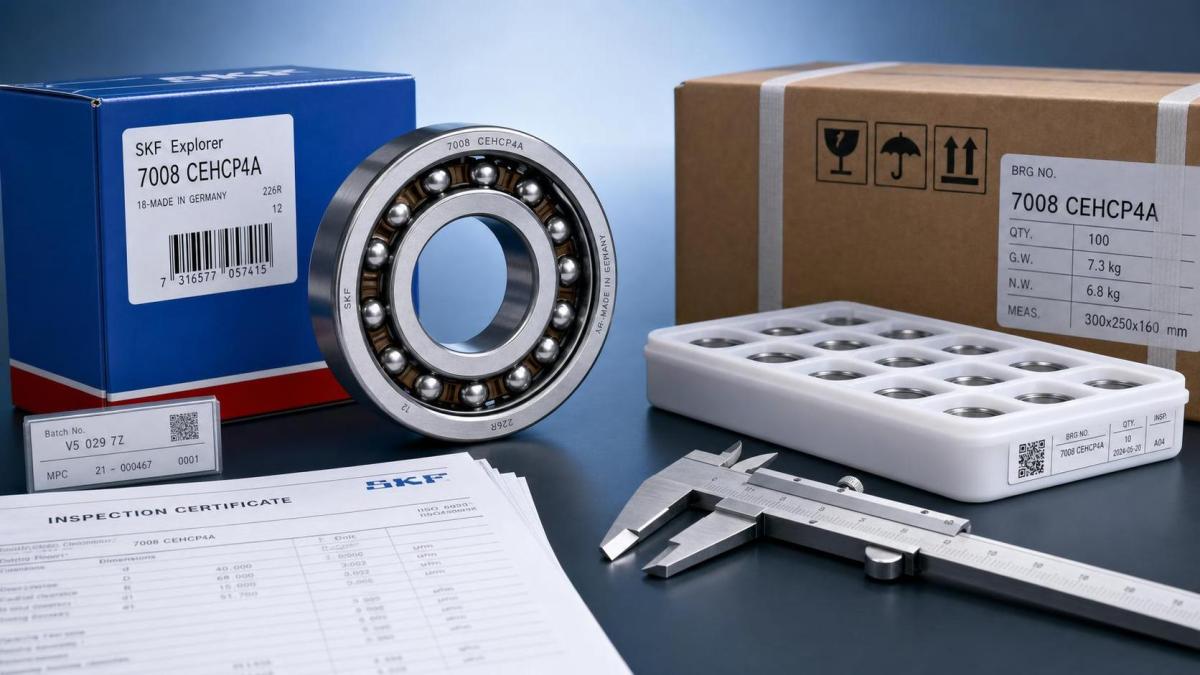
Why do quotes for the same SKF 7008CEHCP4A vary so much?
Because the quote is not only about the bearing. It also reflects stock position, supply channel, packaging condition, documentation quality, and seller risk.
A lower quote can come from older inventory, limited traceability, damaged original packaging, or longer replenishment uncertainty. A higher quote may include immediate availability, clearer batch records, or better export handling. For procurement, that means price differences should be reviewed line by line, not treated as pure margin spread.
How can you reduce the risk of receiving the wrong or questionable bearing?
Use a tighter document-and-inspection routine before payment and again at receiving. In bearing procurement, vague communication is expensive.
- Send the full model code exactly as required on the PO.
- Ask the supplier to confirm the same code back on the quotation and order confirmation.
- Request photos of box labels and product markings for higher-risk or urgent orders.
- Make batch traceability and packaging condition part of the receiving checklist.
- Hold payment exceptions for mismatched markings, repacked goods, or incomplete documents.
This process is simple, but it catches a lot. Common mistakes are accepting a substitute without engineering approval, overlooking suffix differences, and relying on verbal confirmation instead of documents.
When is a lower-cost alternative worth considering?
Only after you separate functional requirement from brand habit. If the SKF 7008CEHCP4A is specified by equipment design, replacement decisions should not be made by procurement alone. But if the application allows equivalent sourcing, then the right question is whether the operating requirement truly needs that exact configuration or whether another bearing family in your inventory strategy can cover adjacent needs.
For example, buyers who manage mixed bearing categories often review standard stock items for less critical positions to free budget for high-precision purchases. In that context, a product such as FAG 6205-H-2Z Deep Groove Ball Bearing may fit a different procurement lane: chrome steel GCr15, 25 mm bore, 52 mm outer diameter, 15 mm width, with multiple precision grades and clearance options available. It is not a substitute for an angular contact bearing by default, but it shows how standardizing suitable positions elsewhere in the BOM can ease cost pressure on specialized items.
What lead time questions should be asked before issuing the order?
Ask for a date, not a promise. “Available soon” is not useful in purchasing.
- Is the SKF 7008CEHCP4A Angular Contact Ball Bearing physically in stock now?
- If not, what is the replenishment source?
- What is the dispatch date from the supplier’s warehouse?
- What is the transit method and estimated arrival date?
- Which part of the lead time is under the seller’s control, and which part depends on transfer or international logistics?
This matters because quoted lead time often mixes procurement lead time, internal handling time, and freight time. A seller with a slightly higher price but real stock can be cheaper overall than a lower quote tied to uncertain inbound inventory.
What documents should purchasing keep on file for this type of order?
At minimum, keep the quotation, purchase order, order confirmation, invoice, packing list, and receiving record tied to the exact bearing designation. If your company uses incoming inspection, link that report to the batch or package marking. The point is not paperwork for its own sake. It gives you a clean path if you need to challenge a mismatch, process a return, or investigate a failure later.
For repeat procurement, these records also improve the next negotiation. You can compare actual delivery performance, claim rate, and acceptance quality instead of relying on memory.
How should buyers decide between one-off purchase and scheduled buying?
If usage is sporadic, a one-off buy may be enough. If the bearing appears in recurring maintenance or production schedules, scheduled buying usually gives better control. Not always lower price, but better control. You reduce urgent freight, improve supplier planning, and lower the chance of taking whatever stock is available at the last minute.
A good rule is to review three things together: annual usage, downtime cost if stock is missing, and storage risk if stock sits too long. That balance tells you whether to hold safety stock, place blanket orders, or buy per demand.
What is the most common procurement mistake with high-precision bearings?
Treating them like commodity items. The SKF 7008CEHCP4A is purchased by part number, but managed by application risk. Buyers who focus only on a fast quote often miss the details that determine whether the bearing will be accepted, installed, and trusted.
The strongest buying approach is straightforward: lock the exact specification first, verify stock and traceability second, then compare total cost across delivery, inspection risk, and replacement exposure. That sequence protects both budget and production.
Navigation
Send Us A Message
consult

Jinan Lanyu Import & Export Co., Ltd. is a bearing manufacturing enterprise specializing in the import and export trade of bearings. Covering a total area of 50,000 square meters, the company boasts an annual production capacity exceeding 20 million sets and is dedicated to the manufacture of high-quality bearings.

First class quality service and professional after-sales team.
Get in Touch
*We respect your confidentiality and all information are protected.
