


A lower 6205 bearing price can make a purchasing report look better without making motor maintenance less expensive. The difference becomes clear when a bearing replacement stops production: the component may be a small part of the bill, while technician time, troubleshooting, and lost output account for much more.
For business decision-makers, the choice is not simply “cheap or premium.” It is whether a bearing is suitable for the motor, consistently manufactured, and supported by a dependable supply channel. Jinan Lanyu, a bearing manufacturer specializing in import and export trade, operates in this purchasing context across deep groove ball bearings, self-aligning ball bearings, and cylindrical roller bearings. The useful comparison is therefore between complete replacement costs—not just competing unit quotations.
What exactly are you comparing when you request a 6205 bearing price?
A standard 6205 deep groove ball bearing has a 25 mm bore, 52 mm outside diameter, and 15 mm width. Those dimensions establish the basic envelope, but they do not describe every feature that matters inside a motor.
Two quotations marked “6205” may cover different closures, internal clearances, lubricants, or quality-control requirements. Open, shielded, and contact-sealed versions have different contamination protection, friction, and lubrication characteristics. Suffix meanings can also vary between manufacturers, so a purchasing team should confirm the specification rather than assume equivalent lettering means identical construction.
Before comparing prices, establish a common specification:
- Bearing configuration: open, shielded, or sealed, consistent with the motor’s lubrication arrangement.
- Internal clearance: selected for shaft and housing fits, temperature differences, and operating requirements.
- Speed and load suitability: verified against manufacturer data for the actual bearing variant.
- Lubrication: grease type, temperature capability, and compatibility with the maintenance plan.
- Acceptance requirements: traceability, inspection documentation, and any defined noise or vibration criteria.
C3 clearance is used in many motor applications, but it is not a universal upgrade. Likewise, a higher precision class is not automatically necessary for an ordinary industrial motor. Paying for the wrong specification is expensive whether the bearing is budget-priced or premium.
The replacement invoice tells only part of the story
When maintenance teams replace a failed motor bearing, the work extends beyond removing one component and installing another. Isolation, motor removal, disassembly, inspection, reassembly, alignment, and test running all consume resources. If the failure damages a shaft seat or housing, the repair scope grows.
A useful comparison separates costs into four categories:
Use a consistent evaluation period, such as the interval between planned shutdowns. Then estimate total cost as purchase and stocking costs, plus expected replacement labor, downtime, and consequential repair costs over that period. Keep overlapping downtime categories separate to avoid counting the same loss twice.
The key word is expected. A premium bearing does not eliminate failures, and a lower-cost bearing is not inherently unreliable. Where failure probabilities are uncertain, compare several scenarios rather than assigning an unsupported service-life advantage to either option.
Where a premium bearing may earn its price difference
The strongest argument for paying more is usually not the brand name alone. It is evidence of tighter manufacturing consistency, appropriate lubrication, controlled cleanliness, and dependable product identification. These factors can matter when a motor operates continuously or has little tolerance for vibration and temperature rise.
Consider a motor that drives a production bottleneck. Even a modest reduction in avoidable bearing-related stoppages may justify a higher purchase price because access, labor, and interruption costs are substantial. The same reasoning applies to motors installed in difficult-to-reach locations or equipment where an unnoticed bearing failure could cause further damage.
A practical break-even test is:
Additional premium purchase cost < expected reduction in replacement, downtime, and repair costs.
Use your own maintenance history to populate that comparison. If reliable records are unavailable, a controlled trial on comparable motors can be more useful than a supplier’s general statement that one bearing “lasts longer.” Record operating hours, loads, temperatures, failure modes, and installation procedures—not just the replacement date.
When a lower-cost option is a rational choice
A competitively priced bearing can make commercial sense in a correctly specified, moderate-duty motor with easy access, available redundancy, and a qualified supplier. In these circumstances, paying for features beyond the application’s needs may add little practical value.
The important distinction is between lower cost and uncontrolled quality. A lower-cost source should still provide identifiable products, consistent specifications, and an agreed response to nonconforming deliveries. Sampling and trial use can help establish confidence before a broader purchasing commitment.
For fleets with mixed duties, one purchasing rule rarely fits every motor. Segmenting equipment by operational consequence allows economical options on low-risk assets while reserving more stringent sourcing requirements for critical equipment.
Check the failure cause before upgrading the bearing
Repeated failures can create understandable pressure to buy a more expensive component. Yet the bearing may be receiving the blame for problems elsewhere in the motor or installation.
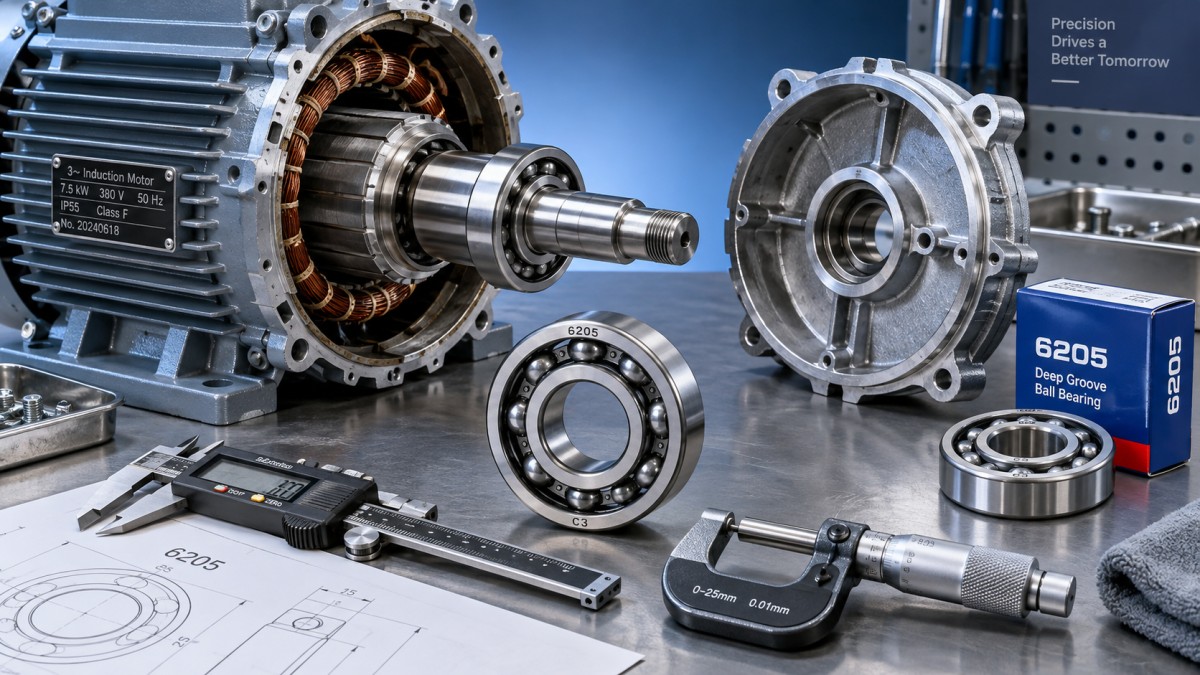
Before approving a change, have maintenance review the failure evidence:
- Mounting damage: installation force transmitted through the rolling elements can damage a new bearing before service begins.
- Incorrect fits or clearance: excessive interference and temperature differences can reduce operating clearance and increase heat.
- Lubrication problems: unsuitable grease, contamination, or incorrect replenishment can undermine either price tier.
- System conditions: misalignment, excessive belt tension, vibration, and ingress may require corrective work beyond bearing replacement.
- Electrical damage: shaft currents in some inverter-driven applications require a system-level assessment; a conventional premium steel bearing alone may not resolve them.
If the root cause remains unchanged, the next bearing may fail for the same reason. Better purchasing and better maintenance need to work together.
A matching bore does not mean a matching replacement
Specification discipline also matters when browsing adjacent bearing products. For example, the SKF UCF205 Radial Insert Ball Bearing Housing Unit is a housed insert-bearing unit listed for OEM applications with a 25 mm bore. It is not a direct replacement for a 6205 bearing installed inside a motor.
A housed unit introduces different mounting, shaft-locking, and assembly requirements. Confirm the drawing, load ratings, supplied configuration, and brand provenance before ordering. Shared bore size is useful for identification, but it is not evidence of interchangeability.
Make the buying decision repeatable
For an import/export bearing supplier such as Jinan Lanyu, a useful quotation request includes the complete bearing designation, motor duty, annual demand, delivery expectations, and required documentation. Ask what is supplied, how batches are identified, and how discrepancies are handled. For branded products, verify sourcing and authenticity rather than relying on packaging alone.
The best 6205 bearing price is the price attached to a suitable, verifiable product with acceptable lifecycle risk. Choose a lower-cost option when the application and supplier evidence support it. Pay more when the additional controls or demonstrated performance address a meaningful business exposure. Above all, judge the purchase by the cost of keeping the motor running—not merely by the cost of putting a bearing on the shelf.
Navigation
Send Us A Message
consult

Jinan Lanyu Import & Export Co., Ltd. is a bearing manufacturing enterprise specializing in the import and export trade of bearings. Covering a total area of 50,000 square meters, the company boasts an annual production capacity exceeding 20 million sets and is dedicated to the manufacture of high-quality bearings.

First class quality service and professional after-sales team.
Get in Touch
*We respect your confidentiality and all information are protected.
