


Deep Groove Ball Bearing vs Cylindrical Roller Bearing
When comparing deep groove ball bearing vs cylindrical roller bearing, the choice is rarely just about price or availability. It changes how a machine carries load, handles speed, tolerates misalignment, and wears over time. In real industrial purchasing, the wrong bearing type often leads to secondary problems: overheating, premature vibration, shaft instability, or maintenance intervals that are shorter than expected.
Jinan Lanyu works in bearing manufacturing as well as import and export trade, with core products including deep groove ball bearings, self-aligning ball bearings, and cylindrical roller bearings. In day-to-day business, the most practical question is not which bearing is “better,” but which bearing fits the actual load path, speed range, mounting condition, and service target of the equipment.
Deep groove ball bearings are widely chosen because they are versatile. They can handle radial load and a certain amount of axial load in both directions, run smoothly at relatively high speed, and are available in a broad range of sizes and sealing arrangements. For motors, pumps, fans, small gearboxes, household equipment, and many general machines, that flexibility is exactly why they remain so common.
Cylindrical roller bearings are built around a different priority. Their line contact between rollers and raceways gives them much stronger radial load capacity than ball bearings of comparable size. In applications where radial load is heavy and axial load is managed elsewhere in the arrangement, they are often the more durable solution. That is why they appear frequently in machine tool spindles, rolling mills, transmissions, electric motors of larger capacity, and other industrial equipment where stiffness matters.
The core difference is contact geometry
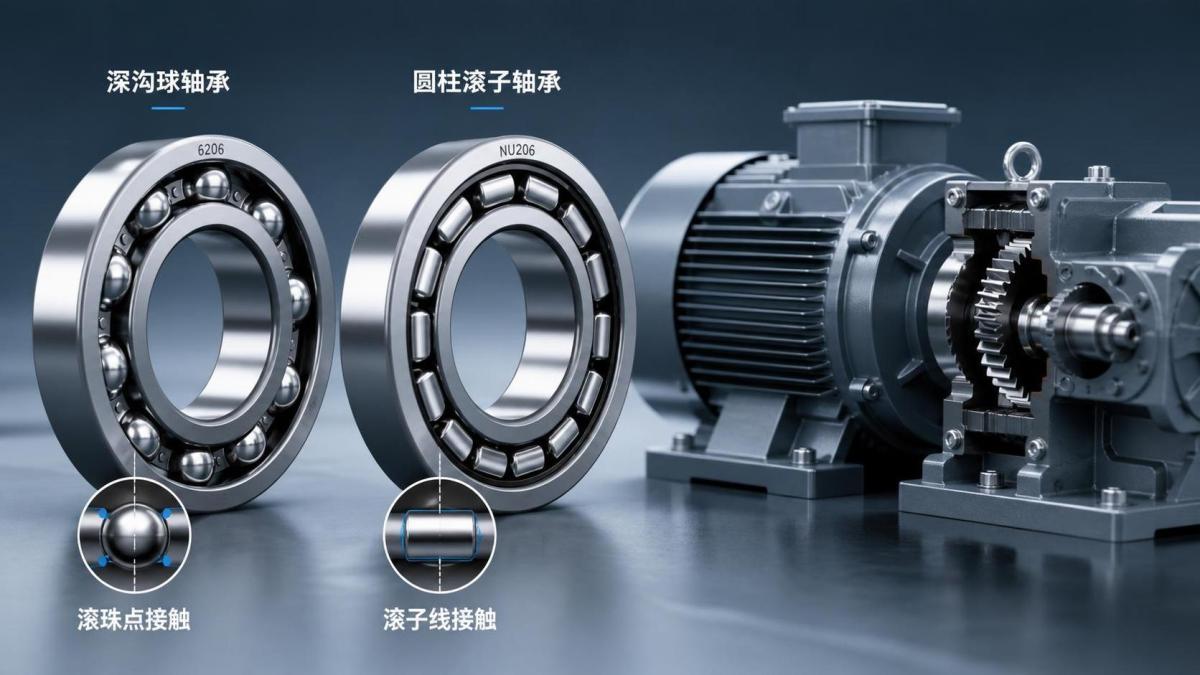
A deep groove ball bearing uses balls, so contact with the raceway is essentially point contact under normal load. This reduces friction and helps with speed performance. A cylindrical roller bearing uses rollers, creating line contact. That spreads load over a larger area and improves radial load carrying ability, but usually with different limits on speed, lubrication sensitivity, and axial behavior.
This sounds theoretical, but it has very practical consequences. If your equipment sees moderate load and high rotational speed, the lower friction of a deep groove ball bearing can be a clear advantage. If the machine sees heavy radial load, shock, or requires higher rigidity at the shaft, cylindrical roller bearings usually deserve closer attention.
How they behave in real operating conditions
One common mistake is to choose cylindrical roller bearings purely for “higher capacity” without reviewing axial load. Many cylindrical roller bearing designs are optimized mainly for radial load, and some arrangements need a separate locating bearing to control axial movement. Deep groove ball bearings, on the other hand, can simplify the system when light axial load exists in both directions.
Another issue is shaft and housing tolerance. Roller bearings can be less forgiving if installation precision, lubrication cleanliness, or internal clearance selection are not matched properly. In a clean, controlled assembly environment, that is manageable. In rough field service conditions, the simpler bearing sometimes wins because the whole system is less sensitive.
Selection is not only about load rating
Engineers and buyers often focus on dynamic load capacity first, but in practice several other checks matter just as much:
- Is there axial load, and in which direction?
- What is the actual speed, not just the motor nameplate speed?
- Will the bearing operate with grease or circulating oil?
- Is heat dissipation limited by enclosure design?
- How accurate are the shaft and housing fits?
- Does the machine need higher stiffness or quieter running?
- Will maintenance staff replace bearings in a workshop or on site?
For example, if a motor-driven fan runs continuously at high speed with moderate radial load, deep groove ball bearings are often the practical answer. If an industrial gearbox carries sustained heavy radial load and shaft deflection needs tight control, cylindrical roller bearings may be more appropriate. The bearing arrangement around them still needs checking, especially if axial positioning is involved.
This is also where suppliers with both manufacturing and trade experience can be useful. Jinan Lanyu handles different bearing categories rather than a single product line, so the discussion can stay focused on fit, clearance, grade, and application, instead of forcing one type into every machine.
Where adjacent bearing types enter the conversation
In actual projects, the comparison does not always stop at ball versus cylindrical roller. Once axial load becomes more significant, tapered roller bearings may become part of the evaluation. In some industrial applications, a bearing such as FAG 33211-XL Tapered Roller Bearing fits better because tapered rollers are designed to carry combined loads more directly. The available specification range can also matter: Chrome steel GCr15 material, steel cage design, precision grades from P0 to P4, and clearance options from C2 to C5 give engineers room to match operating conditions rather than forcing a generic setup.
That does not mean tapered roller bearings replace deep groove ball bearings or cylindrical roller bearings. It means the bearing decision should begin with load direction and system architecture, not with a preferred catalog family.
What buyers should confirm before placing an order
If you are sourcing bearings for OEM production, maintenance stock, or export distribution, a few details are worth confirming early:
- Bearing type and arrangement in the full assembly
- Required precision grade and internal clearance
- Material and cage preference
- Whether sealed or open design is needed
- Expected operating temperature and lubrication method
- Interchangeability with current installed bearings
- Packaging, labeling, and export documentation requirements
Those points sound basic, but many problems in cross-border bearing supply come from incomplete technical confirmation rather than manufacturing defects. A buyer may ask for the same bore and outer diameter while overlooking clearance class, cage style, or fit condition. That is enough to change vibration, temperature rise, and usable life.
The comparison between deep groove ball bearing vs cylindrical roller bearing becomes much clearer once the application is framed correctly. Choose deep groove ball bearings when speed, versatility, and simple combined-load handling matter more. Choose cylindrical roller bearings when radial load and stiffness are the real priorities. If axial load is stronger than expected, it may be time to review other designs instead of stretching either option beyond what it was meant to do.
For teams evaluating a new project or replacing an existing bearing, the best next step is usually to verify load direction, clearance, speed, and mounting structure together. That is where a sound selection starts, and where later maintenance problems are often prevented.
Navigation
Send Us A Message
consult

Jinan Lanyu Import & Export Co., Ltd. is a bearing manufacturing enterprise specializing in the import and export trade of bearings. Covering a total area of 50,000 square meters, the company boasts an annual production capacity exceeding 20 million sets and is dedicated to the manufacture of high-quality bearings.

First class quality service and professional after-sales team.
Get in Touch
*We respect your confidentiality and all information are protected.
