


Start with the contamination level, not the catalog page
When buyers ask whether the NTN-6313ZZCM-Deep Groove Ball Bearing is the right stocking choice, the quickest way to get it wrong is to start from price or brand familiarity alone. In actual trading work, the better starting point is the operating environment. A shielded deep groove ball bearing makes more sense when the application sees dust, light airborne particles, or splash risk, but not the kind of heavy contamination that would call for a different sealing strategy altogether.
That distinction matters for distributors and agents. If your customer runs fans, motors, conveyors, pumps, or general industrial equipment in relatively stable conditions, shielded construction often gives them a cleaner operating window and less frequent maintenance attention. If the equipment lives in slurry, washdown, or persistent fine abrasive exposure, treating a shielded bearing as a cure-all usually ends in returns, complaints, or shortened service life.
So before you quote the NTN-6313ZZCM-Deep Groove Ball Bearing, check what kind of contamination is actually present, how often the machine runs, and whether the customer wants low intervention more than maximum exclusion.
A practical checklist for deciding when shielded is the better fit
- Check whether the application is exposed to light contamination or heavy ingress. Shielded designs are typically a strong answer where dust and debris are present but not being forced directly into the bearing cavity. Ventilation systems, electric motors, and enclosed drive units often fall into this range. Quarry equipment, aggressive washdown lines, and mud-heavy environments usually do not.
- Ask how the machine is lubricated and maintained. One reason buyers choose shielded ball bearings is to reduce routine relubrication attention in equipment that runs continuously. If the maintenance team wants a clean, stable setup with less handling, shielded construction can be easier to support in stock. If the end user expects frequent relubrication access or field disassembly, the conversation changes.
- Look at operating speed and smoothness expectations. Deep groove ball bearings are commonly selected where low vibration and steady running matter. For rotating equipment where noise, drag, and consistent operation are part of the buying decision, a shielded option often makes commercial sense because it balances protection with running efficiency.
- Confirm whether the customer is solving for bearing protection or alignment problems. This is a common sales-side mistake. A shielded deep groove ball bearing helps with contamination control and operational cleanliness. It does not solve misalignment. If the shaft or housing condition points to coaxiality error, a different bearing family may be the better answer.
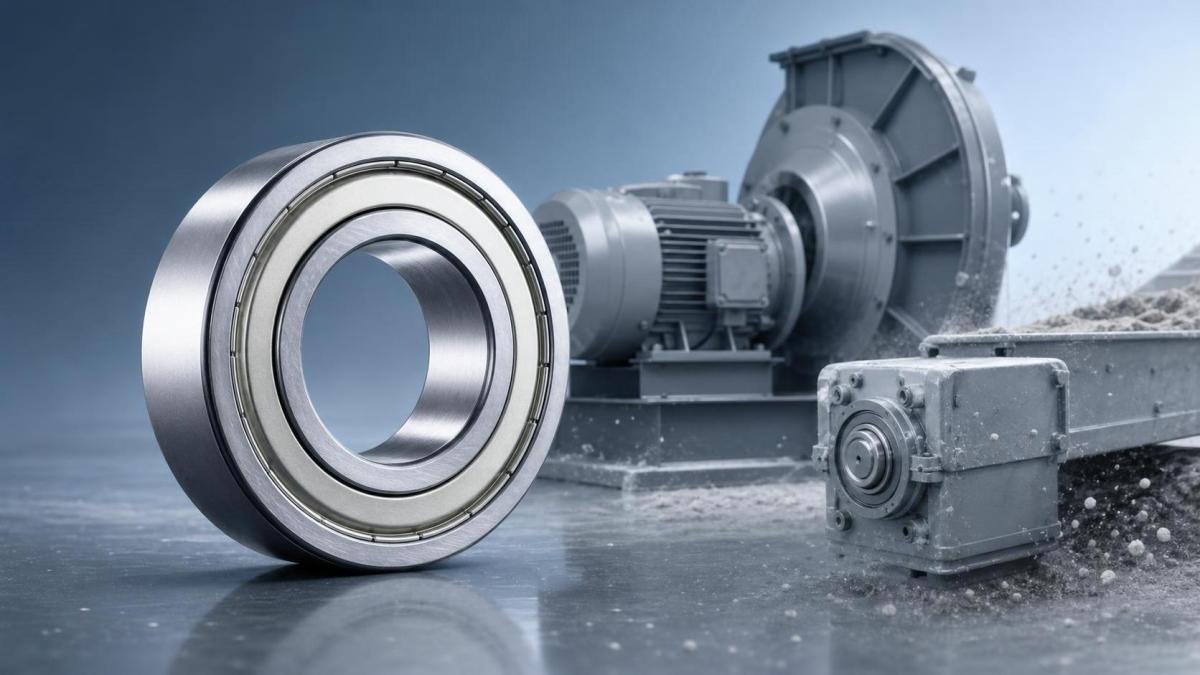
That last point is where experienced distributors usually save time. Some buyers describe failure as “dust getting in,” but once you ask better questions, the real issue turns out to be shaft deflection, mounting error, or vibration load. In those cases, forcing a shielded deep groove bearing into the job can create more trouble than it prevents.
What to verify before you add NTN-6313ZZCM to regular stock
For stock planning, the NTN-6313ZZCM-Deep Groove Ball Bearing is usually worth considering when your customer base includes general machinery users who value predictable supply, smooth running, and moderate contamination protection. But stock decisions should follow demand patterns, not assumptions.
- Review the equipment category. General motors, drive assemblies, agricultural auxiliary systems, and industrial fans are usually better candidates than equipment exposed to persistent liquid contamination.
- Check whether customers repeatedly ask for reduced maintenance handling. That is often where shielded options outperform open-bearing supply from a commercial standpoint.
- Verify replacement behavior. If end users tend to replace bearings as complete units rather than service them in place, shielded stock can be easier to move consistently.
- Ask about failure mode on the previous bearing. Contamination, grease loss, and rough running point one way. Misalignment, overload, and mounting distortion point another way.
A quick screening table for customer conversations
Where buyers often misjudge this bearing
One frequent mistake is treating “shielded” as meaning fully protected under any condition. It does not. It is a practical design choice for a specific middle ground: more protection than open construction, with smooth running characteristics that suit a wide range of general machinery.
Another mistake is ignoring the customer’s installation reality. If the equipment suffers from shaft misalignment, vibration load, or repeated mounting and dismounting, you may need to move the discussion away from deep groove ball bearings. In those situations, bearing types designed for high radial load, axial load capability in either direction, and alignment compensation can be the better technical answer. That is where products such as Spherical roller bearings may enter the conversation, especially in applications that need good lubrication and cooling characteristics or installation on a smooth shaft without a shoulder.
How experienced distributors usually frame the recommendation
The most reliable way to position the NTN-6313ZZCM-Deep Groove Ball Bearing is simple: recommend it when the customer needs dependable running in a moderately contaminated environment, wants a cleaner bearing arrangement, and is not trying to fix alignment or extreme load problems with the wrong product type.
In practical terms, the order of checks should be:
- Environment: dust level, splash risk, and whether contaminants are light or aggressive
- Duty: continuous running, expected smoothness, and maintenance interval
- Failure mode: contamination problem, lubrication issue, overload, or misalignment
- Replacement pattern: quick swap stock item or application requiring a different bearing concept
That sequence keeps the recommendation grounded. It also helps you avoid the expensive habit of matching a familiar part number to the wrong failure cause. For agents, wholesalers, and distributors, that is usually the difference between a bearing that moves well and a bearing that comes back as a problem.
Navigation
Send Us A Message
consult

Jinan Lanyu Import & Export Co., Ltd. is a bearing manufacturing enterprise specializing in the import and export trade of bearings. Covering a total area of 50,000 square meters, the company boasts an annual production capacity exceeding 20 million sets and is dedicated to the manufacture of high-quality bearings.

First class quality service and professional after-sales team.
Get in Touch
*We respect your confidentiality and all information are protected.
