


Why does bearing accuracy matter so much in high-speed machining?
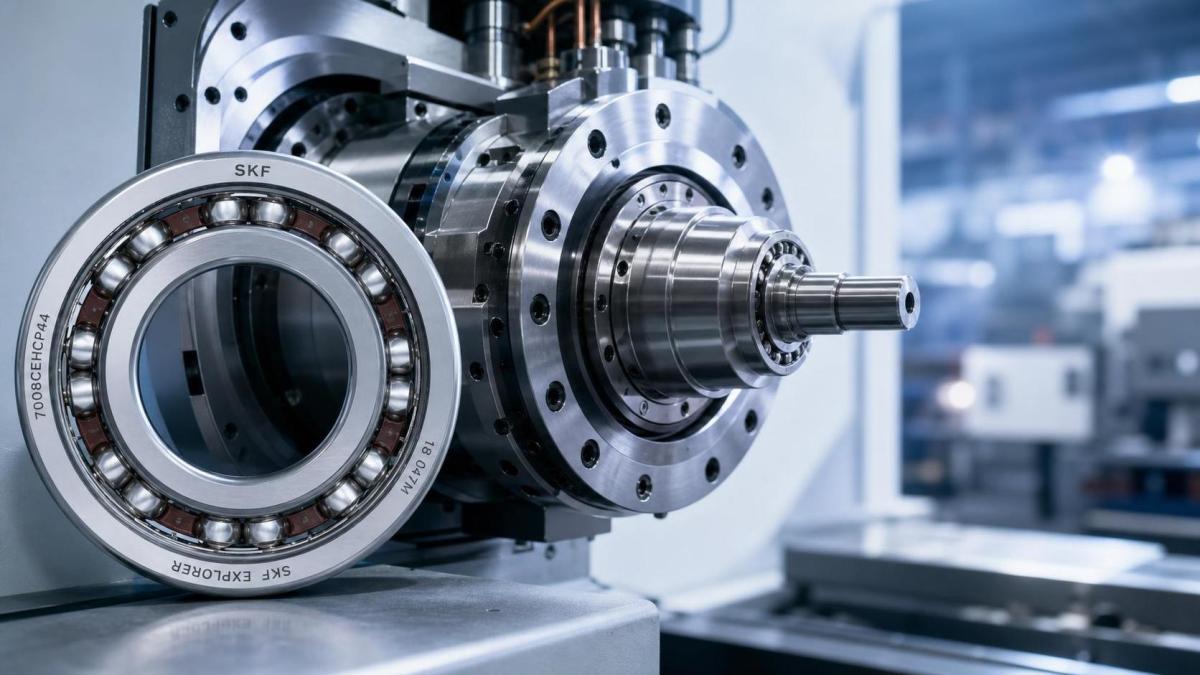
When a spindle is running fast, small errors stop being small. A slight deviation in the bearing can show up as chatter, uneven surface finish, rising heat, or tool marks that seem hard to explain. That is why the SKF 7008CEHCP4A Angular Contact Ball Bearing gets attention in precision machining setups. Its job is not just to let the shaft rotate. It helps the spindle hold a more stable running position under speed and load.
For end users, that usually translates into three practical outcomes: tighter machining consistency, less vibration during demanding cycles, and fewer surprises when machines are pushed close to their normal production limits. If you are comparing replacement options, this is the part that matters most: a high-speed spindle only performs as well as the bearing accuracy supporting it.
What does the SKF 7008CEHCP4A actually do inside a machining setup?
This bearing is an angular contact ball bearing, which means it is built to handle combined loads, especially where radial load and axial load act together. In a machine tool spindle, that matters because cutting forces rarely stay in one clean direction. The bearing has to support speed while also keeping shaft movement controlled.
The accuracy benefit comes from how well the bearing maintains rotational precision. In real terms, that helps reduce runout, limits shaft deflection under operating load, and supports smoother tool engagement with the workpiece. A spindle that runs more true generally cuts cleaner, sounds calmer, and holds tolerances more reliably over long shifts.
Will it improve surface finish, or is that too much to expect from one bearing?
It can improve surface finish, but only in the way a critical spindle component improves the whole cutting system. A bearing does not fix poor tooling, weak clamping, or incorrect feed rates. What it does is remove one common source of instability.
If the previous bearing had wear, preload loss, excess vibration, or running inaccuracies, replacing it with the correct SKF 7008CEHCP4A Angular Contact Ball Bearing can make a visible difference. Users often notice better repeatability first, then cleaner finishes, especially on fine milling, grinding-adjacent operations, or parts where spindle smoothness affects the final result directly.
If the machine already has alignment issues elsewhere, the improvement may be limited. That is why bearing upgrades should always be judged alongside spindle condition, housing fit, lubrication method, and installation quality.
How can you tell whether this bearing suits your machine?
Start with the spindle design, not the catalog name. The right question is whether your machine requires this specific bearing arrangement, size, contact behavior, and precision level. Before buying, check:
- the existing bearing designation from the machine manual or old bearing marking
- spindle speed range and operating duty
- whether the bearing is mounted as a single unit or in a matched set
- shaft and housing fits
- lubrication approach used in the spindle
A common mistake is assuming that matching the dimensions is enough. It is not. In high-speed machining, internal design and precision class affect behavior just as much as size does. If the machine was built around a specific spindle bearing configuration, swapping to a different type without checking the original setup can reduce accuracy instead of improving it.
Is vibration reduction one of the real advantages?
Yes, but again, it is part of a system result. A properly selected and properly installed precision angular contact bearing helps the spindle rotate more smoothly. That smoother rotation lowers the chance of vibration building up at speed, which is especially important when cutting hard materials or working with fine tolerance parts.
For end users, vibration reduction matters for reasons beyond noise. It can help protect tool life, reduce edge chipping, and keep dimensional drift under control during long runs. If you see a machine leaving inconsistent finish patterns that come and go with speed changes, the spindle bearing condition is one of the first areas worth checking.
What usually goes wrong when people replace spindle bearings?
Most problems come from installation and handling, not from the bearing label itself. Precision bearings are easy to compromise before the machine even starts.
This is why buyers should confirm not only the model but also the mounting arrangement and service condition around it. In spindle work, details that look minor on paper can decide whether the machine runs cleanly or fails early.
Does this bearing work for every misalignment problem?
No. An angular contact spindle bearing is meant for precision and load control, not for forgiving larger alignment errors. If your machine has shaft deflection issues, mounting inaccuracies, or operating conditions where angular misalignment is expected, a different bearing type may be more suitable in another part of the machine.
That is where Self-aligning ball bearings are worth understanding. They are used in applications such as precision instruments, low-noise motors, automobiles, motorcycles, and general machinery. Their spherical outer ring raceway allows automatic self-alignment, helping compensate for eccentricity and shaft deflection. In general use, the inner ring, balls, and cage can tilt relative to the outer ring, with a maximum relative inclination of 3 degrees and an operating temperature range of -30℃ to +120℃.
That does not make them a substitute for a spindle bearing like the SKF 7008CEHCP4A. It simply shows that bearing choice depends on the job. Precision machining accuracy usually calls for strict spindle control, while other assemblies may benefit more from self-alignment.
What should an end user check before ordering a replacement?
Use the machine documentation first, then verify against the bearing marking removed from the spindle if available. Do not rely on appearance alone. The safer path is to confirm the full designation, machine model, spindle arrangement, and whether the replacement is part of a matched pair or set.
If your goal is better machining accuracy rather than simple machine restart, also check why the old bearing is being replaced. If failure came from contamination, poor lubrication, or fit damage, installing a new bearing without fixing that root cause usually gives a short-lived result.
So when is the SKF 7008CEHCP4A the right move?
It is the right move when the spindle was designed for this bearing type and the goal is stable, high-speed rotational accuracy under real machining load. If your machine is showing signs like worsening finish, increased vibration at speed, or loss of repeatability, the bearing can be a key part of the solution.
One practical rule helps here: do not judge the bearing only by whether it fits into the spindle. Judge it by whether it preserves the spindle’s intended accuracy, speed behavior, and load support. In high-speed machining, that difference is where performance is won or lost.
Navigation
Send Us A Message
consult

Jinan Lanyu Import & Export Co., Ltd. is a bearing manufacturing enterprise specializing in the import and export trade of bearings. Covering a total area of 50,000 square meters, the company boasts an annual production capacity exceeding 20 million sets and is dedicated to the manufacture of high-quality bearings.

First class quality service and professional after-sales team.
Get in Touch
*We respect your confidentiality and all information are protected.
