Selecting an SKF FNL513A Cast flanged housing requires more than matching a bearing designation. Approval depends on documented compatibility across the complete bearing assembly.
Technical evaluators must verify the bearing arrangement, shaft dimensions, mounting interface, and seal configuration against manufacturer specifications before approving an assembly for service.
A mismatch can compromise fit, lubricant retention, or protection against contamination. A bearing that fits the shaft may still be unsuitable for the housing.
This article outlines a practical compatibility process for assessing candidate bearings and seals, identifying documentation gaps, and clarifying requirements with suppliers such as Jinan Lanyu.
Which Documents Establish FNL513A Compatibility?
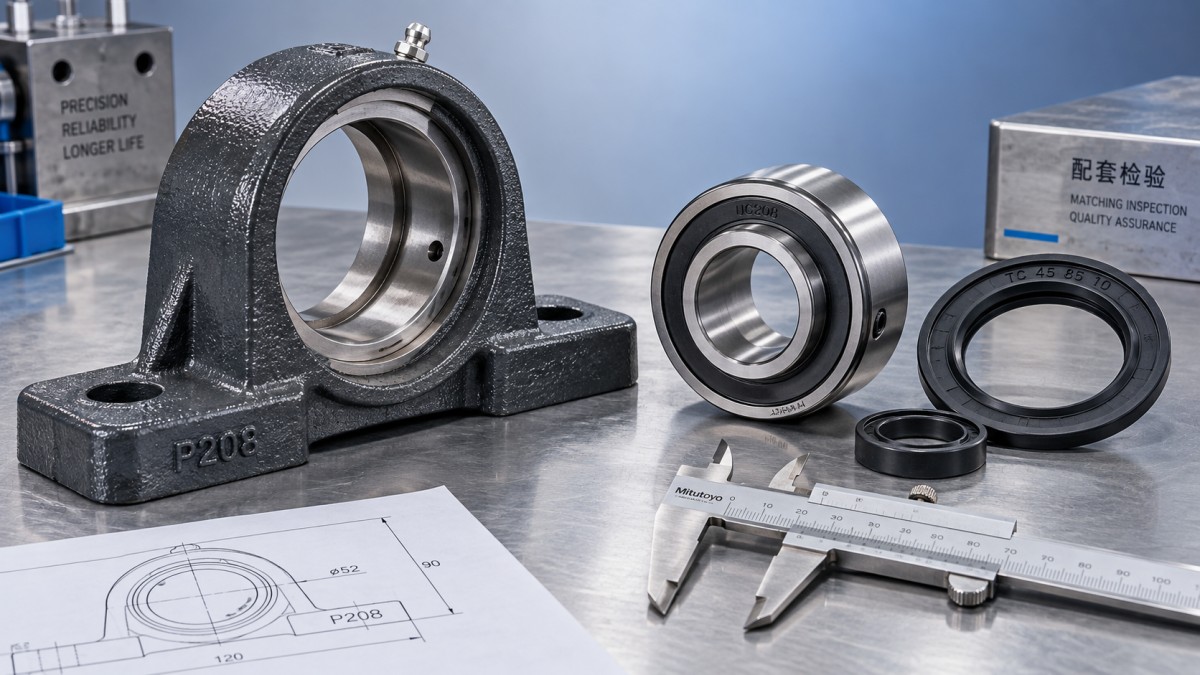
Start with the current manufacturer drawing and product documentation for the exact housing designation. The designation alone does not establish every bearing or seal option.
Record the designation as printed on the component, packaging, and quotation. Resolve differences in suffixes, spacing, or revisions before treating supplier descriptions as equivalent.
Request the housing drawing, approved bearing combinations, associated sleeve or locking components, seal references, and installation instructions. These documents establish the assembly under review.
Separate verified dimensions from assumptions. If a quotation lacks a bearing reference or seal designation, mark compatibility as unresolved rather than inferring it from photographs.
Also establish the operating conditions: shaft speed, load direction, temperature, contamination, lubrication method, and expected shaft movement. These determine whether an approved combination suits the application.
A useful review package connects each selected component to a manufacturer reference. A general statement that parts are “suitable for FNL513A” provides insufficient engineering evidence.
Does the Bearing Match the Housing Seat and Mounting Arrangement?
Check the manufacturer's approved bearing series first. Matching a bore diameter does not prove that the outer ring, width, or locating arrangement suits the housing.
Compare bearing outside diameter and width with the housing seat and available axial space. Include any locating rings or spacers specified for the arrangement.
Then establish how the bearing mounts on the shaft. A cylindrical bore and a tapered bore with an adapter sleeve require different dimensional checks.
For sleeve mounting, verify the complete sleeve designation, shaft diameter, locking hardware, and installation method. Do not substitute a sleeve based solely on nominal size.
Assess internal clearance using the actual fit and operating temperature. Mounting a tapered bore bearing can reduce clearance, making the prescribed adjustment procedure especially important.
Check allowable misalignment against the bearing and housing documentation. A self-aligning bearing does not remove limits imposed by seals, adjacent equipment, or shaft geometry.
Finally, confirm load capacity and speed suitability for the duty. Dimensional compatibility is necessary, but it does not establish adequate bearing life or acceptable operating temperature.
Can the Shaft, Housing, and Machine Interface Work Together?
Review shaft drawings at every functional surface: bearing seat, sleeve position, seal contact area, shoulders, and locking features. Each surface serves a different compatibility requirement.
Check specified shaft tolerances against the selected mounting method. A nominal diameter without its tolerance cannot establish fit, assembly force, or resistance to ring creep.
Evaluate shoulder geometry and fillet clearance where applicable. Interference at an abutment can prevent proper seating even when the principal bearing dimensions appear correct.
For the flange interface, compare bolt pattern, mounting face, register dimensions where specified, and surrounding clearance with the machine drawing. Confirm access for assembly tools.
Assess the supporting structure and fasteners using the manufacturer's mounting requirements. Uneven support or inappropriate tightening can affect alignment and stress the cast housing.
Identify whether this position locates the shaft axially or permits displacement. The complete machine arrangement must accommodate thermal expansion without creating unintended axial loads.
Record axial travel requirements and check them against bearing retention and seal behavior. Approval should cover the operating range, including startup and shutdown temperature changes.
Which Seal Configuration Fits the Actual Operating Conditions?
Seal selection begins with the exact housing configuration and shaft diameter at the sealing position. Request approved seal references rather than choosing by appearance.
Establish whether the housing requires a through-shaft configuration or an end closure. These arrangements use different components and must match the actual shaft layout.
Describe the contamination realistically: airborne dust, abrasive particles, splash water, or cleaning exposure. A seal suitable for one environment may perform poorly in another.
Compare the manufacturer's available sealing options against shaft speed, temperature, lubricant, and environmental exposure. Contact and noncontact designs involve different friction and exclusion characteristics.
For contact seals, verify required shaft finish, hardness where specified, runout, and material compatibility. A damaged sealing surface can undermine an otherwise correct selection.
For labyrinth arrangements, confirm clearances and any prescribed grease supply or replenishment method. Their effectiveness depends on installation geometry and the intended operating conditions.
Check permissible axial movement and eccentricity for the selected seal. A bearing arrangement that accommodates displacement may still exceed the seal's permitted movement range.
Do not equate bearing shields with housing seals. Shields fitted to a bearing do not automatically provide adequate protection at the housing's shaft openings.
How Should You Assess an Alternative Bearing Offered by a Supplier?
An alternative should enter the evaluation as a separately documented candidate. Compare its designation, dimensions, mounting method, clearance, and performance with the approved assembly requirements.
For example, the FAG6304-C-2Z Deep Groove Ball Bearing listing gives dimensions of 20 × 52 × 15 mm. Those dimensions alone do not establish FNL513A compatibility.
The supplied listing describes chrome steel GCr15, a weight of 0.15 kg, and several precision and clearance options. Verify these details for the quoted item.
Request documentation supporting the exact supplied designation, material, and selected specification. A catalogue of available grades does not identify which version will actually arrive.
A deep groove ball bearing also requires an application review when the intended arrangement relies on self-aligning behavior. Similar dimensions cannot replace that functional assessment.
Jinan Lanyu's stated portfolio includes deep groove ball bearings, self-aligning ball bearings, and cylindrical roller bearings. Ask for technical documentation specific to each proposed component.
Require the quotation to distinguish the housing, bearing, seals, sleeve, and locking hardware. This makes omissions visible and prevents a partial supply becoming an assumed assembly.
What Evidence Is Needed Before Procurement Approval?
Use a review record that identifies each requirement, the supporting drawing or specification, and its approval status. Keep unresolved assumptions visible until evidence closes them.
Before ordering, resolve missing dimensions, ambiguous suffixes, and unsupported substitution claims. Conditional approval should identify the outstanding evidence and prevent premature release for installation.
At receipt, compare component markings and supplied quantities with the approved bill of materials. Inspect condition and verify critical dimensions using the agreed inspection method.
Approve the SKF FNL513A Cast flanged housing assembly when bearing, shaft, mounting, and seal requirements are supported by consistent documentation. That evidence makes procurement decisions defensible.
The decisive question is whether the complete assembly suits the machine and operating conditions. Establishing that fit before purchase reduces avoidable installation problems and rework.